


























.svg)
.svg)
.svg)
Building Reliable Web Data Pipelines for LLMs and RAG Systems with Proxies (2026)
The scraping layer is where most RAG pipelines quietly fall apart. Here's how to build one that doesn't.
RAG systems are only as good as the data they retrieve. Most teams get the vector database and embedding model right, then watch performance degrade because the scraping layer keeps breaking. Proxies are the fix, but the type matters.
- RAG adoption is accelerating fast. A Snowflake survey found 71% of early GenAI adopters already implementing RAG to ground their models. The scraping infrastructure to feed those pipelines is not keeping up.
- The scraping layer is the fragile part. Rotating proxies, session management, geo-targeting, and anti-bot bypass all need to work continuously for your knowledge base to stay current.
- Datacenter IPs fail on most production data sources. Residential proxies are the baseline for reliable scraping at scale. ISP static proxies handle multi-step document crawls that need session continuity.
- Data freshness is a RAG-specific problem. Stale embeddings produce confidently wrong answers. Your proxy infrastructure needs to run continuously, not just once at ingestion.
- Geo-targeting lets you collect localized content that would otherwise be invisible, which matters for multilingual knowledge bases and region-specific pricing data.
I've spent a fair amount of time building and maintaining data pipelines that feed into LLM applications. The vector database choices get the most attention. The embedding models get debated endlessly. And then the scraping layer breaks in production and nobody catches it for two weeks because the LLM keeps returning answers, just wrong ones based on stale data from six weeks ago.
This guide is about the infrastructure layer that most RAG tutorials skip: how proxies fit into a production scraping pipeline, what types to use where, and how to build a system that actually stays live. Let's get into it.
Why RAG Pipelines Break at the Data Layer
RAG pipelines fail for one of three reasons. The retrieval model is weak. The chunking strategy produces bad context windows. Or the data the model is retrieving is wrong. The first two get fixed in code. The third keeps breaking silently in production and takes a while to notice.
Here's the failure pattern. Your scraper collects data on day one. Embeddings go into the vector store. The pipeline performs well. Two weeks later, a target site changes its structure, adds Cloudflare protection, or just starts rate-limiting your IP. The scraper fails quietly, returning 403s or empty responses that get discarded. New data stops flowing in. The knowledge base grows stale. The LLM keeps answering queries confidently using the old data.
That's the specific danger of stale RAG data: it doesn't look broken. The system still responds. It just responds incorrectly. A Towards Data Science analysis on LLM grounding makes the point clearly: RAG systems are only as fresh as the data they retrieve, and any lag in ingestion leads to hallucinations in the form of outdated answers. This is the failure mode worth engineering against.
The fix starts with a scraping layer that is more resilient than the retrieval layer it feeds.
What Is a RAG Pipeline (The Technical Reality)
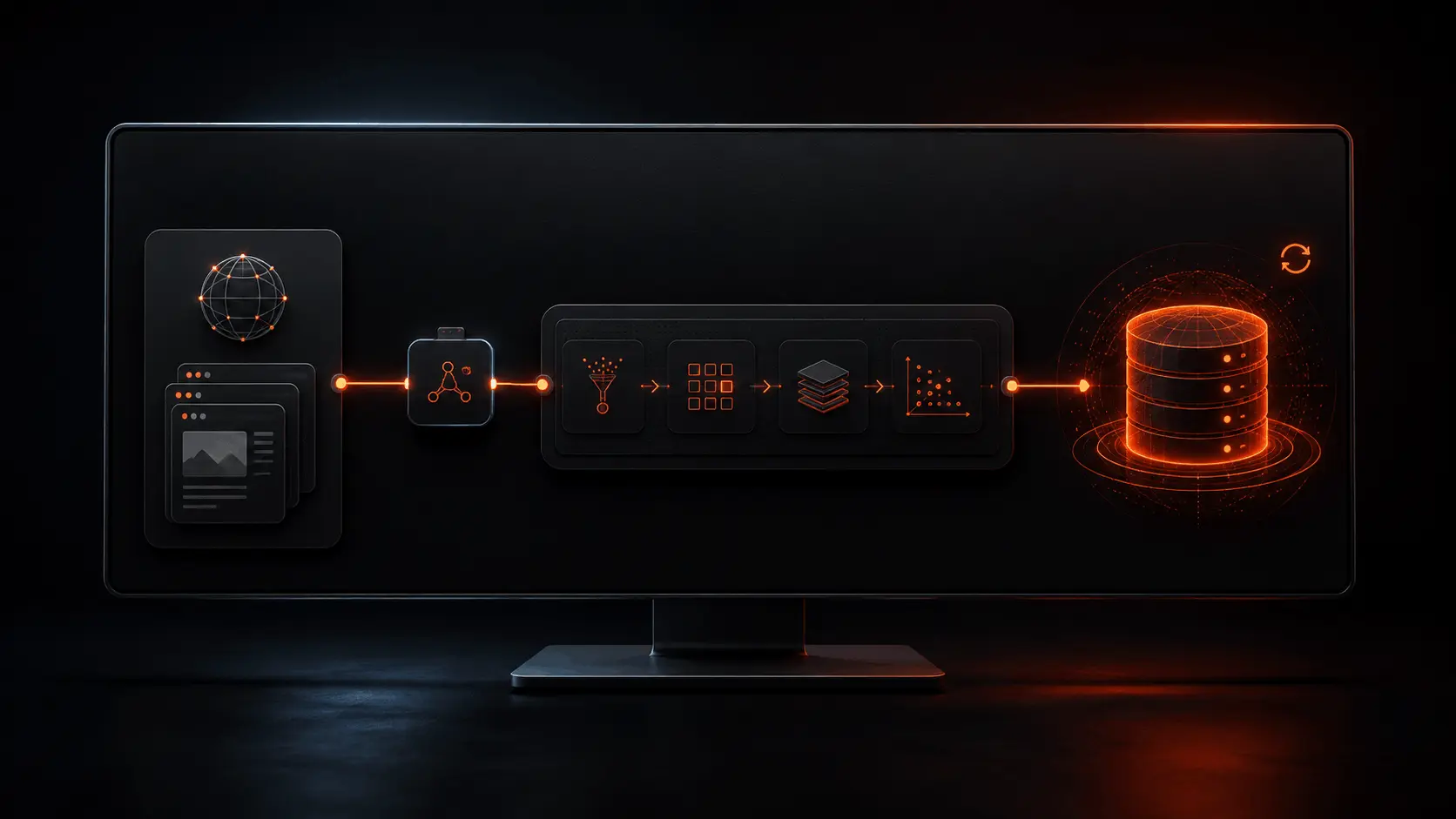
A production RAG pipeline has five stages: data ingestion, cleaning and parsing, chunking and embedding, vector storage, and retrieval plus generation. Web scraping happens at stage one. What the scraper collects determines everything downstream.
The RAG market reflects how seriously teams are taking this architecture. MarketsandMarkets estimates the RAG market at USD 1.94 billion in 2025, projected to reach USD 9.86 billion by 2030 at a 38.4% CAGR. A survey from k2view found 86% of enterprises are augmenting their LLMs with frameworks like RAG, recognizing that out-of-the-box models don't meet their specific needs.
The bottleneck in most of these deployments isn't the retrieval algorithm. It's the data pipeline feeding it.
RAG vs. LLM Training: Different Infrastructure Needs
This is worth stating directly because the two get confused. LLM training needs a massive, one-time (or infrequent) corpus collection: diversity, scale, and deduplication matter most. You scrape huge volumes once, clean the data, and feed it to a training run. RAG needs continuous, targeted re-ingestion from a defined set of sources: freshness, structure, and retrieval quality matter most. You scrape a smaller set of URLs repeatedly, on a schedule.
| Dimension | LLM Training | RAG Pipeline |
|---|---|---|
| Collection pattern | Large, one-time or periodic bulk | Continuous scheduled refresh |
| Source diversity | As broad as possible | Specific, curated domains |
| Freshness requirement | Less critical (training run, not live) | Critical (stale = wrong answers) |
| Volume per run | Billions of pages over weeks | Thousands to millions per day |
| Proxy requirement | High-volume rotating residential | Reliable residential + ISP static for sessions |
| Session management | Not critical | Critical for multi-page document crawls |
Where Web Scraping Fits in the RAG Stack
The full pipeline from web page to LLM response has five stages. The proxy infrastructure touches the first one, but its reliability determines everything that follows.
Stage one produces raw HTML. Stage two converts that HTML to clean, LLM-readable text. This matters more than most guides acknowledge. A large share of web pages contain 40-60% boilerplate: navigation menus, footers, ads, cookie banners, and script tags. If the scraper passes raw HTML to the next stage, those embeddings get polluted with noise. The retrieval system then surfaces navigation text as context for your LLM. The downstream quality hit is real.
The toolchain for stages two through five is fairly mature: Firecrawl or Crawl4AI for HTML-to-Markdown conversion, LangChain or LlamaIndex for chunking and embedding orchestration, Pinecone, Qdrant, or FAISS for vector storage. Stage one is where the implementation breaks. That's the proxy problem.
Why Proxies Are Infrastructure, Not Optional
Every target website has rate limits. Most high-value data sources have bot detection. Repeated requests from a single IP, at any meaningful volume, trigger blocks. This isn't a theoretical risk; it's the default behavior of production web infrastructure.
According to Apify's State of Web Scraping report 2026, 65.8% of professionals used more proxies in 2025 than the year before, and 58.3% increased their proxy budgets. The report notes that volume and complexity, not price, are driving costs as scraping operations scale and anti-bot systems become more aggressive.
For a RAG pipeline specifically, the consequence of skipping proxy infrastructure is predictable. You ingest data on day one from your development machine or a single server IP. The pipeline works. At some point, the source website notices repeated requests from the same IP and throttles or blocks it. Your refresh jobs start returning empty responses. The knowledge base goes stale. You don't notice until someone reports wrong answers.
The other 43.1% of web scraping professionals in the same Apify survey now use two or three proxy providers, reflecting a multi-provider approach that builds redundancy into the scraping stack. For a RAG pipeline where data freshness is a product requirement, that kind of redundancy is worth thinking about from the start.
Proxy Types and Which RAG Stage Each Serves
Not all RAG data sources need the same proxy configuration. The right proxy type depends on the target's bot protection level, whether the scrape needs session continuity, and how geographically specific the data is.
Residential Rotating Proxies: The Standard Choice
For most RAG ingestion jobs, residential rotating proxies are the right default. They draw from real ISP-assigned IP addresses, which pass the IP reputation checks that fail datacenter IPs immediately on protected sites. Each request can come from a different IP, distributing the request load so no single address triggers rate limiting.
What this means for a RAG pipeline: your scheduled refresh jobs can run continuously against sources like news sites, product pages, documentation, and research publications without hitting blocks that stop data flow. The rotation happens at the proxy layer so your scraper logic stays simple.
ISP Static Proxies: Session Continuity for Multi-Page Crawls
Some RAG data sources require multi-step access: login pages, paginated document sets, multi-step form navigation, or resources that track session state across requests. Rotating IPs break session continuity. A new IP on request three after the session was established on request one triggers re-authentication or session expiry on many platforms.
ISP static proxies give you a dedicated IP that stays consistent for the duration of a session. This is the right tool for crawling structured documentation behind a login, paginating through protected databases, or navigating sites that use IP-based session tracking.
Hybrid Proxies: Mixed Sources for Protected Targets
For RAG pipelines pulling from heavily protected targets (sites behind Cloudflare, DataDome, or HUMAN Security), a hybrid pool that combines ISP, mobile, and residential IPs gives you better coverage than any single source type. Mobile carrier IPs carry higher trust scores with most bot detection systems because they're harder to correlate with proxy infrastructure. For a pipeline that needs to scrape from a protected source on a recurring basis, that trust score advantage compounds over time.
| Proxy Type | Best RAG Use Case | Session Stability | Bot Protection Coverage |
|---|---|---|---|
| Residential Rotating | Bulk ingestion, news, product pages, open docs | Per-request rotation | Good |
| ISP Static | Multi-page crawls, session-gated sources, paginated docs | Persistent session | Moderate |
| Hybrid (ISP + Mobile + Residential) | Protected targets, enterprise sites, high-security sources | Configurable | Best |
| Datacenter | Public APIs, open government data, Wikipedia | N/A | Fails on most protected sites |
One thing I want to be straight about: for open, unprotected sources like Wikipedia, government data portals, or internal documentation that lives behind your own infrastructure, datacenter IPs or no proxies at all are completely fine. Don't over-engineer it. The proxy requirement scales with the protection level of your sources.
Data Freshness: The Silent RAG Killer
RAG was designed to solve the knowledge cutoff problem. Pre-trained LLMs stop knowing things after their training date. RAG gives them a mechanism to access current information at query time. But that mechanism only works if the data going into your vector store is actually current.
This is worth stating more bluntly. If your RAG pipeline ingested pricing data in March and it's now May, your LLM is answering pricing questions with March data. If you're in a domain where that gap matters, like competitive intelligence, compliance, or financial research, your RAG system is actively producing wrong outputs with no error signal. The LLM answers confidently. The answer is just old.
Freshness Requirements by Data Type
Not all data sources decay at the same rate. Structuring your refresh schedule around data type saves unnecessary scraping volume while keeping the knowledge base current where it matters.
- Pricing and inventory data: Refresh every few hours. This category changes constantly and stale data produces wrong outputs immediately.
- News, press releases, regulatory updates: Daily refresh cycles. Events happen fast and context-sensitive queries need current information.
- Product documentation, API references: Weekly. Changes less often but version-specific queries can go wrong on stale docs.
- Research papers, academic content: On-event or monthly. Pull new publications as they're indexed rather than re-scraping old ones constantly.
- Stable reference content (Wikipedia, historical records): Monthly or less. This doesn't change often and the scraping cost isn't worth the freshness gain.
Change Detection: Don't Re-Scrape What Hasn't Changed
Re-scraping unchanged pages wastes proxy bandwidth and generates redundant embedding updates. The practical way to handle this is checking HTTP response headers before committing to a full scrape. Most web servers include an ETag or Last-Modified header. A conditional GET using If-None-Match or If-Modified-Since returns a 304 Not Modified response if nothing has changed, at a fraction of the data cost. Your pipeline skips the parse-and-embed step entirely. Only changed pages get re-ingested.
Structuring the Scrape-to-Vector Pipeline
The thing that catches most people here is treating the pipeline as a one-time batch job rather than a continuous system with state. A scrape-to-vector pipeline for a production RAG system needs four components beyond the scraper itself: a URL queue, retry logic, a freshness tracker, and an update mechanism for the vector store.
URL Queue and Priority
Maintain a queue of target URLs with associated metadata: last scraped timestamp, ETag value, change frequency estimate, and priority score. High-frequency sources go at the front of the queue. Sources that haven't changed in six runs get deprioritized. Tools like Airflow, Redis queues, or even a simple scheduled cron with a SQLite state file all work depending on your scale. What matters is that the system has memory of what it's already seen and can decide intelligently what to scrape next.
Proxy Rotation at the Request Level
Configure proxy rotation at the request level, not the session level, for bulk ingestion. Your scraper selects a new residential IP from the pool for each page request. For sources requiring session continuity, switch to sticky sessions that hold the same ISP static IP for the duration of the crawl. This distinction is worth getting right before you scale; it's a configuration issue, not an architecture change, but the wrong setting on a protected multi-page source will produce incomplete data.
What this actually means in practice: your proxy credentials URL looks like username:[email protected]:31112 for rotating, or uses the sticky session parameter from the dashboard for fixed-IP crawls. The scraper configuration sets it once per target group; you don't need to change it per-request in your code.
Retry Logic and Circuit Breakers
Every scraping pipeline needs exponential backoff for 429 and 503 responses. Start with a 1-second delay, double it on each retry, cap at 60 seconds, and abort after five attempts. Log every failure with the source URL, status code, and proxy IP so you can identify systematic issues: a specific target blocking your IP range, a source going down, an anti-bot system tightening up.
A circuit breaker per domain is worth implementing once you have more than a few sources. If a single domain fails more than three consecutive times, mark it as degraded and skip it for the next run cycle. This prevents a single broken source from consuming all your retry budget while other sources queue up behind it.
Incremental Vector Store Updates
Re-embedding the entire knowledge base every time a source updates is expensive and unnecessary. Most vector databases support upserts: update the embedding for a specific document if its content has changed, leave others untouched. Store a content hash alongside each URL in your state tracker. On re-scrape, hash the new content and compare. If the hash matches, skip embedding. If it differs, generate a new embedding and upsert it into the vector store. This keeps the knowledge base current without burning embedding API tokens on unchanged content.
Geo-Targeting and Localized Knowledge Bases
This is the part most RAG pipeline guides skip entirely. Many websites serve different content depending on where the request originates: localized pricing in the visitor's currency, region-specific news and regulatory updates, translated product descriptions, country-specific inventory data. A single-location scraper misses all of this.
For a RAG pipeline that needs to answer questions across markets, geo-targeting is a data quality issue, not a proxy configuration detail. If your competitive intelligence tool pulls pricing data from a US IP and your users ask about UK pricing, the knowledge base doesn't have the right information regardless of how good your retrieval model is.
City-level geo-targeting lets your pipeline collect location-specific content systematically. Scrape the same product page from a London residential IP, a Tokyo residential IP, and a New York residential IP, store the content with location metadata, and your vector store contains the full picture. At retrieval time, the query context can filter to the relevant geographic content before the LLM generates a response.
TorchProxies supports country, state, and city-level targeting across 195 countries on supported plans. For RAG pipelines covering multiple markets, this replaces what would otherwise be separate scraping contracts per region, which is a meaningful operational simplification I haven't seen other proxy guides address in this context.
Session Management for Multi-Page Document Crawls
Academic databases, enterprise documentation portals, legal research platforms, and financial data sources often organize content across paginated sequences or require authenticated access to reach the actual documents. These are exactly the high-quality sources that make a RAG knowledge base valuable. They're also the ones where rotating IPs cause the most problems.
When you log in to a source and get assigned a session token, the session is typically tied to your IP. Rotating to a new residential IP on page three of a twenty-page document set breaks the session. You get logged out or redirected to an error page. The crawl returns incomplete data, which produces truncated context in your vector store.
The solution here is sticky sessions using ISP static IPs. You establish the session from a consistent IP address, maintain that IP for the duration of the crawl, and rotate only between document sets rather than between pages. The session stays alive, the pages arrive complete, and your embeddings cover the full document rather than the first two pages.
Honestly, this is simpler than it sounds. The configuration is a single setting in the proxy dashboard: sticky session with a chosen timeout. Set it long enough to cover your longest expected crawl cycle on that source and you're done.
TorchProxies for RAG and LLM Data Pipelines
A few specifics on how TorchProxies fits into this architecture.
Plan X at $5/GB is the right choice for RAG pipelines pulling from protected sources. The hybrid pool combines 120M+ IPs drawing from ISP, mobile, and residential sources. Mobile carrier IPs carry the highest trust scores with bot detection systems, which matters when your pipeline needs to run recurring scrapes against targets using DataDome or Cloudflare's Managed Challenge. The higher IP quality reduces the retry rate and keeps data flowing without constant intervention.
For pipelines with simpler source profiles, open sites, documentation, and low-protection data sources, Standard Residential at $4/GB covers the job at lower cost. The 30M+ residential IP pool is sufficient for rate-limit avoidance at most reasonable RAG ingestion volumes.
ISP Static Proxies at $4/GB per IP is the product for session-critical crawls. The dashboard lets you switch authentication between SOCKS5 and HTTPS per plan, which matters if your pipeline connects to sources using different transport requirements. You can run session-persistent crawls against documentation portals and rotate freely against public sources from the same account without managing separate proxy contracts.
What TorchProxies doesn't include: browser rendering, HTML-to-Markdown conversion, or the LLM extraction layer. The proxy infrastructure handles IP rotation, geo-targeting, and session management. The rest of the pipeline stack (Firecrawl, Crawl4AI, LangChain, LlamaIndex) sits on top of it. If you're just starting to build the pipeline and haven't picked those tools yet, the combination of TorchProxies residential proxies with Crawl4AI for open-source self-hosted pipelines, or with Firecrawl for managed Markdown output, covers the full ingestion layer without much integration work.
Free trial is available without a credit card. The onboarding questionnaire is worth completing; it's short and the plan recommendation is usually right.
One honest limitation: not all special pools are available on all plans, and city-level geo-targeting requires checking which plans support it for your target countries. If precision geo-targeting for a specific market is a requirement, confirm the targeting depth before committing to a plan.
When You Don't Need This
Worth saying plainly. If your RAG knowledge base pulls exclusively from internal data sources, your own documents, your own database exports, your own support tickets, then none of this applies. You control the sources, there are no rate limits, and no anti-bot systems are standing between your scraper and the content.
If you're pulling from a small number of well-behaved public sources without bot protection and your refresh frequency is low (weekly or monthly), a single server IP with reasonable request pacing may be sufficient for years without ever hitting a block. Test it first rather than assuming you need proxy infrastructure from day one.
Proxies become necessary when you're scraping at volume, when sources have bot protection, when you need session continuity on protected sites, or when your freshness requirements push refresh frequency into daily or hourly cycles. The point where that threshold gets crossed depends entirely on your source profile. Some RAG pipelines never reach it.