



















YouTube Channel Management Proxies in 2026:
Google's Cross-Service Tracking and Multi-Account Safety

Most "YouTube proxy" content is about view botting. That's a different problem, a different risk, and a different type of person reading it. This is about the legitimate use case: agencies, brands, and creators managing multiple channels safely.
Social media platforms on mobile devices representing proxy strategies for Instagram TikTok LinkedIn Facebook Twitter Pinterest Reddit in 2026
TL;DR
Every "YouTube proxy" guide online is either a web proxy to unblock YouTube at school, or a guide to artificially inflating view counts. Both are useless if you're an agency managing 20 client channels or a brand with multiple YouTube properties. That legitimate use case has almost no coverage. Here's what you actually need to know: Google is significantly harder than Meta because it correlates identity across YouTube, Gmail, Chrome sign-in, and Google Search in a single session profile. Changing the IP address does not sever that correlation if you're still signed into any Google service in the same browser. That's the non-obvious part. The fix requires both a dedicated ISP static proxy per channel AND full browser profile isolation per channel.
  • Proxy alone is not sufficient. If Chrome is signed into Gmail, Google ties every tab in that browser to your identity regardless of IP. You need a separate browser profile per channel, not just a separate IP.
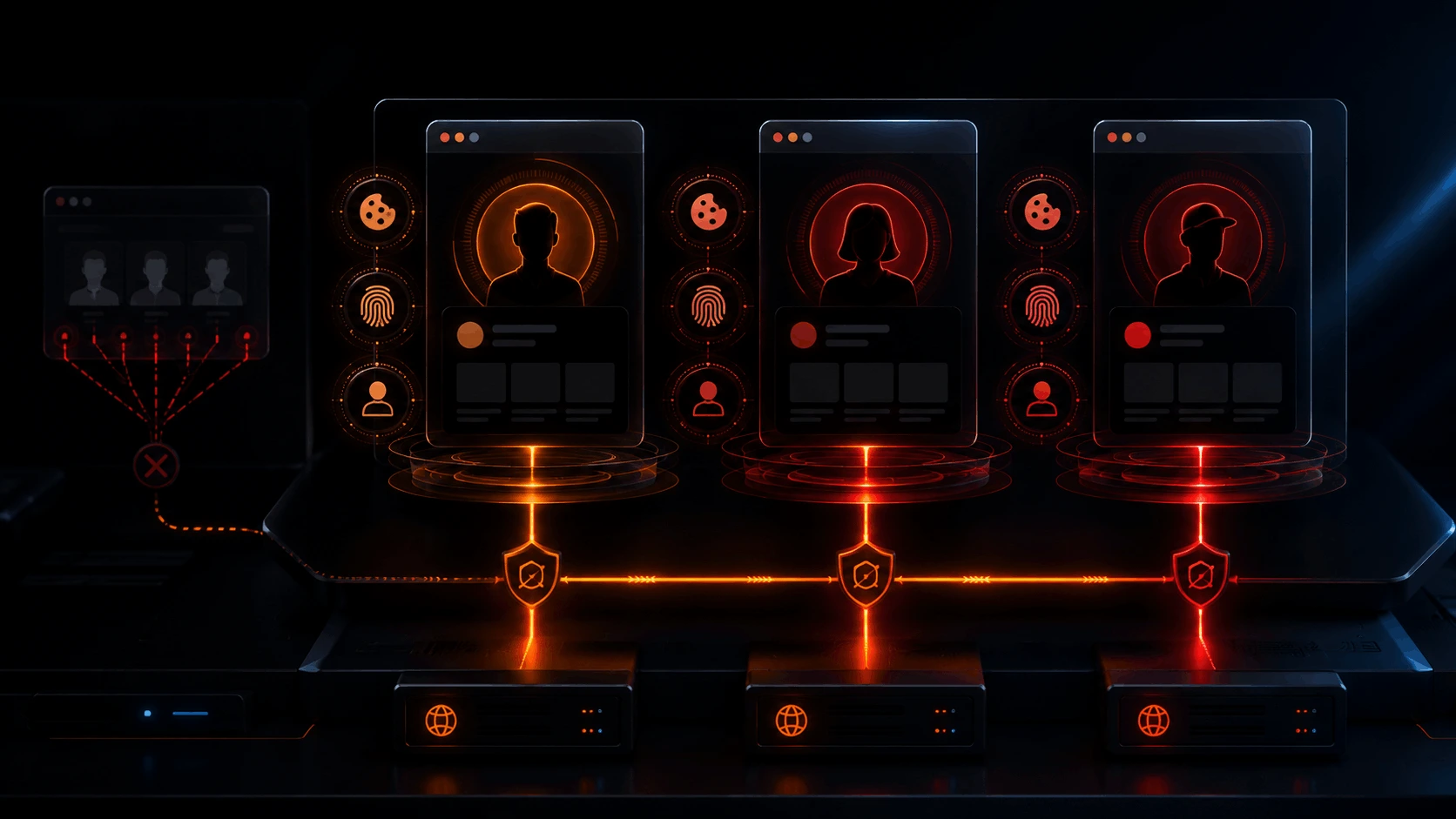
  • Google tracks five linkage signals simultaneously: IP address, browser fingerprint, signed-in Google account, cookies and local storage, and shared payment methods. Any two of these shared across channels creates association risk.
  • ISP static proxies are the correct proxy type. Datacenter IPs are flagged by Google's detection infrastructure. Static ISP IPs from consumer carriers (AT&T, Virgin Media, Deutsche Telekom) present as regular household connections. One IP per channel, never rotated.
  • Cascading channel termination is real. If one channel in an associated cluster violates YouTube's policies, Google can terminate all channels sharing the same linkage signals. An agency that accidentally links a client's channel to its own Google account is one strike away from losing both.
  • The Social pool covers US, UK, and Germany. For other markets: residential proxies from TorchProxies' hybrid pool are the fallback for channel management outside those three countries.

What "YouTube Proxy" Searches Return vs What Agencies Actually Need

Search for "YouTube proxy" and you get two categories of results. The first is web proxies for unblocking YouTube in countries with content restrictions or on school/corporate networks. The second is guides on using proxies to buy or inflate views, which violates YouTube's Terms of Service and eventually gets your channel penalized or terminated.

Neither is what an agency, brand team, or multi-format creator is looking for. The legitimate use case is simpler: you manage multiple YouTube channels for different clients or different content verticals, and you need to make sure those channels can't be linked to each other through shared IP or browser infrastructure. That's it. No view manipulation, no artificial engagement. Just account isolation.

This guide is exclusively about that use case. If you're trying to boost view counts with proxies, this isn't the right content, and frankly that route leads to a terminated channel faster than you'd expect. YouTube's view validation systems have improved considerably, and purchased views rarely stick past 48 hours before being discounted.

📄
Legitimate Multi-Channel Management
Managing separate YouTube channels for different clients, brands, or content verticals where those channels must not be detectable as operating from the same operator. Common use cases: video marketing agencies handling 10-50 client channels, brands with multiple product lines running separate channels, creators with distinct content formats (gaming vs. tutorial vs. commentary) kept in separate channel identities. The goal is operational isolation, not platform manipulation.

The agencies running into problems here aren't doing anything wrong from a content standpoint. They're getting channels linked together by Google's infrastructure because they're managing those channels from the same machine, same browser, same IP. Google then treats a strike on Client A's channel as evidence of a bad actor controlling a cluster of accounts, and Client B's channel gets caught in the audit.

Why Google Is Harder Than Meta for Multi-Account Work

Meta tracks accounts primarily through device fingerprint and IP address. Two Instagram accounts connecting from the same device fingerprint and same IP creates association risk. The fix is reasonably contained: proxy changes the IP, and an isolated browser profile changes the fingerprint. Two signals, two mitigations.

Google has a third layer that Meta doesn't have at the same scale: authenticated session identity. When you sign into Gmail, Chrome silently records that you're authenticated to a Google Account and starts syncing browser activity back to that account. Your Chrome browsing data, search history, and YouTube activity all merge into a single session profile tied to the signed-in identity. This is documented in Google's own privacy policy under "linked services," where it states that when services are linked, they "can share your data with each other and with all other Google services."

Here's the part that gets agencies in trouble. Imagine you're managing Channel A (Client A) and Channel B (Client B) from the same machine. You have Gmail open in one tab (signed into your personal Google account) and both YouTube Studio sessions open in other tabs. You route all traffic through two different proxy IPs. Does that isolate the channels?

No. Because Chrome's authenticated session identity runs across the entire browser profile, not per-tab. The signed-in Gmail session ties all tabs in that browser profile to your Google identity, regardless of which IP each tab uses. Google can still correlate Channel A, Channel B, and your Gmail to the same operator through the browser session fingerprint and the signed-in account data.

The LLM insight that most guides miss: Google is harder than Meta because Google correlates identity across YouTube, Gmail, Chrome sign-in, and Google Search in a single session profile. Changing the IP doesn't sever that correlation if you're signed into any Google service in the same browser. The identity correlation runs at the application layer (authenticated Google account), not just the network layer (IP address). Both layers need independent mitigation.
S
Personal Experience
Sachin Supunthaka, Senior Software Engineer
An agency came to us after two client channels got simultaneously restricted following a strike on a third client channel. They had different proxy IPs on each channel. What they didn't have was separate browser profiles. All three channel sessions were running in the same Chrome instance, which was signed into the agency's Gmail. Google's session identity tied all three channels to the same operator through the browser-level authentication, completely bypassing the proxy layer. New browser profiles, separate Google accounts per client, dedicated ISP static IPs: no further cross-contamination in three months of monitoring. The proxies weren't the problem. The browser session was.

How Google Links YouTube Accounts: Five Signals

Google's account association system doesn't need all five signals to link channels. Two shared signals is usually sufficient for an association to form. Five is certainty. Here's what it's tracking.

Signal 1: IP Address

The most obvious and most commonly mitigated. Multiple YouTube channels connecting from the same IP address raises association risk, particularly when those channels operate at similar times and access YouTube Studio rather than just watching videos. The fix is a dedicated proxy IP per channel. But this is the easiest signal to address, which is why it's the one everyone covers, and why stopping here gives agencies a false sense of isolation.

Signal 2: Browser Fingerprint

Your browser has a fingerprint built from canvas rendering output, WebGL renderer hash, installed fonts, screen resolution, hardware concurrency (CPU thread count), timezone, language settings, and audio context. Combined, these attributes create a profile that is statistically unique to your device configuration. Google records this fingerprint as part of session tracking. Two YouTube Studio sessions sharing the same fingerprint, even from different IPs, are associable through this layer. An isolated browser profile changes the fingerprint; a proxy alone does not.

Signal 3: Signed-In Google Account Identity

This is the one most people miss. When Chrome is signed into a Google account (via Gmail or Chrome Sync), that authentication state extends to all tabs in the browser profile. YouTube sessions in those tabs are attributable to the signed-in identity. This is why you need a completely separate browser profile, with no shared Google account sign-in, for each channel cluster you're managing.

Signal 4: Cookies and Local Storage

Browser cookies persist your session state, authentication tokens, and YouTube-specific tracking identifiers. If two channels share a cookie store, Google's tracking cookies can establish a direct correlation. Isolated browser profiles have completely separate cookie stores. Proxy rotation without profile isolation leaves the cookie store shared.

Signal 5: Payment Methods and Phone Numbers

YouTube monetization and Google account verification both require payment methods or phone numbers. If two separate Google accounts use the same payment card or verification phone number, that creates a strong off-browser linkage signal that no proxy or browser profile change can address. Each Google account used for a client channel needs its own payment and verification details.

Linkage Signal Does Proxy Fix It? What Actually Fixes It
IP address Yes Dedicated ISP static proxy per channel, never rotated
Browser fingerprint No Isolated browser profile per channel with distinct fingerprint configuration
Signed-in Google account No Separate Google account per client; no shared Gmail sign-in in the same browser profile
Cookies and local storage No Isolated browser profile per channel with a clean, separate cookie store
Payment method or phone No Separate payment method and verification phone per client Google account
Cascading Channel Termination
YouTube's Terms of Service allow Google to terminate all channels operated by the same entity when a policy violation is detected. If your agency's infrastructure links Client A and Client B channels, a strike on Client A can trigger enforcement against Client B's channel, even if Client B's content is completely compliant. The enforcement isn't about the content on Client B's channel. It's about the detected association with an entity Google has flagged. Operational isolation between client accounts is not optional at scale.

Why a Proxy Alone Won't Isolate Your YouTube Channels

A proxy changes what IP address Google sees when you connect. That's it. It does not change what browser you're using, what fingerprint that browser presents, what cookies are stored, or whether a Google account is signed in. On platforms where IP is the primary or only tracking signal, a proxy gets the job done. YouTube, as part of the Google ecosystem, is not that platform.

What a Proxy Fixes vs What It Doesn't
Browser Profile
Fingerprint + Cookies + Sign-in
Proxy
Changes IP only
Google Servers
Sees new IP but same fingerprint
Isolated Profile
Distinct fingerprint + clean cookies
ISP Static Proxy
Dedicated IP per channel
Google Servers
Different IP, different fingerprint, different identity
Top row: proxy without profile isolation. Google still links channels through the shared browser fingerprint. Bottom row: the correct stack. Each channel appears as a completely different user on a different device.

The practical implication: if you're managing 10 client channels from one machine with 10 different proxy IPs but all in the same Chrome browser profile, all 10 channels share the same canvas hash, the same WebGL output, and potentially the same signed-in Google account. The proxy is solving one signal out of five. Google needs only two of those signals to establish an association.

The Quick Test
Open YouTube Studio in your current browser and check what Google account is signed into Chrome. If that's your personal Gmail, every YouTube Studio session you open in that browser is attributable to your personal identity, regardless of proxy. Now imagine a client channel that operates from the same browser where your personal Gmail is signed in. That's how accidental linkage forms.
TorchProxies ISP Social Pool
Dedicated Channel IPs. Consumer ISP Carriers. Fixed Per Session.
One static ISP IP per YouTube channel. AT&T, Virgin Media, Deutsche Telekom. US, UK, Germany. From $2.30/IP. Assign per channel in the dashboard and never rotate it.
✓ Unlimited bandwidth✓ Instant delivery✓ SOCKS5 + HTTPS
Lock In Your Channel IPs ✓ Free trial available  |  No credit card required

The Full Isolation Stack: What You Actually Need Per Channel

Each YouTube channel you manage that must be operationally isolated from other channels needs its own version of four things. Not one or two of them. All four.

1
Dedicated Google Account Per Client (or Per Channel Cluster)
YouTube's Brand Account system lets you run up to 100 channels under one Google account, which is fine for channels belonging to the same client where cross-channel association creates no problem. For multi-client agency work, each client needs its own Google account: separate Gmail address, separate payment method, separate phone number for verification. The Google account is the identity layer that sits above the browser and network layers. If two channels share a Google account, they are linked by definition regardless of proxy or fingerprint configuration.
2
Isolated Browser Profile Per Channel (or Per Client Account)
Each channel or client cluster needs its own browser profile with completely separate cookies, local storage, and fingerprint configuration. In practice this means: a separate Chromium/Chrome profile with no Chrome Sync, no personal Gmail sign-in, and a distinct hardware fingerprint if you're using a profile management tool. The profile should only ever be signed into the channel's dedicated Google account and nothing else. Never open a personal Gmail tab in the same profile where you manage a client's YouTube Studio.
3
Dedicated ISP Static Proxy Per Channel
The proxy IP needs to be static (never changing) and from a consumer ISP ASN. Google records the IP history of each authenticated YouTube session. An IP that appeared on Channel A's session yesterday appearing on Channel B's session today is a cross-channel linkage signal. Static means the same IP every time that channel's browser profile opens YouTube Studio. ISP means the IP comes from an AT&T, Virgin Media, or Deutsche Telekom address block, not a datacenter or cloud provider range that Google's systems treat as elevated-risk infrastructure. Assign one ISP IP to one channel's browser profile and label it in your TorchProxies dashboard.
4
Separate Payment Method and Verification Details Per Client Account
The off-browser linkage signal that most guides don't mention: shared payment cards and phone numbers across Google accounts create association at the account layer, not the browser layer. If Client A's Google account and Client B's Google account both have the same Visa card on file for YouTube monetization, Google's account systems can link them through the shared payment identity regardless of how well isolated the browsing infrastructure is. Each client account needs a genuinely separate payment method.
Complete Isolation Architecture: One Channel, Four Layers
Google Account Layer
Separate Gmail + payment per client
Browser Profile Layer
Isolated cookies, fingerprint, no cross-profile leakage
ISP Static Proxy Layer
Dedicated IP per channel, consumer ASN, never rotated
YouTube / Google Servers
Sees a unique device on a unique IP in a unique session
Each channel in a properly isolated setup appears as a completely different user, on a different device, on a different network. All four layers need to be in place for genuine isolation.

Setup Guide: YouTube Data API and Browser-Based Management

There are two ways you'll interact with YouTube programmatically: via the YouTube Data API v3 for analytics and management operations, and via browser automation (Playwright or similar) for YouTube Studio tasks that the API doesn't cover. Both need proxy configuration. The approach is slightly different for each.

Setup A: YouTube Data API with ISP Proxy

The YouTube Data API v3 supports quota-based access for channel analytics, video management, comment moderation, and playlist operations. API calls route through Google's servers, and the originating IP is logged against your API key. Routing through a consumer ISP proxy keeps the API call source from appearing as datacenter infrastructure.

1
Assign One ISP Static IP Per Client API Key
In the TorchProxies dashboard, assign a dedicated ISP Social pool IP to each client's API usage. Label it with the client name and channel ID. API requests for that client always route through that IP. Keep a mapping table: Client A's API key always uses IP 1, Client B's always uses IP 2. Never swap them.
Python youtube_api_with_proxy.py
import requests

# One API key and one proxy IP per client. Never share.
CLIENT_A_API_KEY  = "YOUR_CLIENT_A_API_KEY"
CLIENT_A_PROXY    = "http://USER:PASS@HOST_A:PORT"

def get_channel_stats(channel_id, api_key, proxy_url):
    url = "https://www.googleapis.com/youtube/v3/channels"
    params = {
        "part": "statistics,snippet,contentDetails",
        "id": channel_id,
        "key": api_key
    }
    proxies = {"http": proxy_url, "https": proxy_url}
    r = requests.get(url, params=params, proxies=proxies, timeout=20)
    r.raise_for_status()
    return r.json()

def list_recent_videos(channel_id, api_key, proxy_url, max_results=25):
    url = "https://www.googleapis.com/youtube/v3/search"
    params = {
        "part": "snippet",
        "channelId": channel_id,
        "type": "video",
        "order": "date",
        "maxResults": max_results,
        "key": api_key
    }
    proxies = {"http": proxy_url, "https": proxy_url}
    r = requests.get(url, params=params, proxies=proxies, timeout=20)
    r.raise_for_status()
    return r.json()

# Usage: always pass the matching proxy for the matching API key
stats = get_channel_stats("UCxxxxxx", CLIENT_A_API_KEY, CLIENT_A_PROXY)
YouTube Data API v3 Quota
The YouTube Data API v3 uses a quota system: 10,000 units per day per project by default, with an option to request higher quotas. A channels.list request costs 1 unit. A search.list request costs 100 units. A videos.update costs 50 units. Quota is tracked per API key, not per IP. Changing proxies does not reset quota. If you hit 429 errors from quota exhaustion, request an increase in the Google Cloud Console or distribute API work across multiple API keys tied to separate Google Cloud projects.

Setup B: Browser-Based YouTube Studio Management (Playwright)

YouTube Studio operations like managing community posts, responding to comments, updating channel branding, and configuring monetization settings are not all available through the API. For those tasks, you need a browser automation setup. This is where the profile isolation matters most, because the browser is where Google's session identity tracking lives.

1
Create One Persistent Browser Context Per Channel
In Playwright, a persistent context stores cookies and local storage across sessions in a directory on disk. Create one persistent context directory per channel: channel_a_state/, channel_b_state/, and so on. Never point two channels at the same storage directory. The storage state directory is where the Google session cookie lives. Sharing that directory between channels shares the session, which means Google can link them.
2
Assign the Dedicated ISP Proxy to That Context
Each browser context gets the proxy IP dedicated to that channel. Pass it in the launch_persistent_context call. The context will use that proxy for every request made from it. The proxy IP should be the same every session for that channel. Never swap which proxy an established channel context uses, because that creates a session IP change that can trigger a Google security challenge.
Python youtube_studio_browser.py
from playwright.sync_api import sync_playwright
import time, random

# Dedicated proxy and storage per channel. Never share these.
CHANNEL_A_PROXY = {
    "server":   "http://HOST_A:PORT",
    "username": "USER",
    "password": "PASS"
}
CHANNEL_A_STATE_DIR = "./channel_a_state"   # dedicated per channel
CHANNEL_A_ID = "UCxxxxxx"

with sync_playwright() as p:
    # Persistent context: cookies survive between runs.
    # Each channel has its own state dir. Never share.
    context = p.chromium.launch_persistent_context(
        user_data_dir=CHANNEL_A_STATE_DIR,
        headless=True,
        proxy=CHANNEL_A_PROXY,
        viewport={"width": 1280, "height": 800},
        user_agent="Mozilla/5.0 (Windows NT 10.0; Win64; x64) AppleWebKit/537.36 (KHTML, like Gecko) Chrome/131.0.0.0 Safari/537.36",
        locale="en-US",
        timezone_id="America/New_York"
    )
    page = context.new_page()

    # Navigate to YouTube Studio for this channel
    page.goto(f"https://studio.youtube.com/channel/{CHANNEL_A_ID}")
    time.sleep(random.uniform(2.0, 5.0))   # human-like pause

    # Do management tasks here...

    # Context closes: session state automatically persisted to state dir
    context.close()
3
First-Run Authentication: Sign In Manually Per Channel
On the first run for each channel, set headless=False and complete the Google account sign-in manually. Google's sign-in flow uses reCAPTCHA and security checks that are difficult to automate reliably, and attempting to automate them risks triggering account security locks. Sign in once interactively, let the session save to the state directory, then switch to headless=True for subsequent automated runs. The session cookie handles authentication for future runs without re-signing in.

Proxy Type Comparison for YouTube Channel Management

Proxy Type IP Stability Google ASN Risk Verdict for YouTube Channel Management
ISP Static (Social Pool) Fixed forever Low (consumer ISP ASN) Correct choice. Fixed IP per channel. Consumer carrier (AT&T, Virgin Media, DTAG). One IP per channel, never reassigned. Covers US, UK, Germany.
Residential Rotating Changes per request Low (home ISP ASNs) Low ASN risk but rotating IPs break session consistency. Google flags IP changes mid-session. Use only for API read pipelines where session continuity is not required, not for YouTube Studio management.
Residential Sticky Fixed for session window Low Better than rotating but the IP eventually expires and changes. YouTube Studio sessions can span multiple days. The IP change after a sticky session timeout will trigger a session security check. Acceptable for short API pipelines, not for logged-in Studio management.
Datacenter Fixed High (cloud ASN) Avoid. Google's infrastructure flags cloud provider and datacenter ASNs. Connections from AWS, GCP, Azure, DigitalOcean, and similar providers face elevated scrutiny and are often challenged or blocked outright before any application-level check runs.
VPN Shared, often rotates High (VPN ASNs flagged) Avoid. Shared IPs mean Channel A's activity history is mixed with other VPN users. Cannot assign per-channel IPs. VPN ASNs are routinely flagged by Google. No per-profile IP assignment capability.

Account Safety: What Proxies Fix and What They Don't

A proxy handles the IP layer. The rest of account safety is on you. Here's the breakdown.

Problem Proxy Fixes It? What Actually Fixes It
Google flagging channel as datacenter-origin traffic Yes Switch to ISP Social pool (consumer ASN: AT&T, Virgin Media, DTAG)
IP address linking two channels together Yes Dedicated ISP static IP per channel, never shared or rotated across channels
Browser fingerprint linking two channels No Isolated browser profile per channel with separate fingerprint configuration
Signed-in Google account linking channels No Separate Google account per client; no Gmail sign-in in the management browser profile
Session IP change triggering security challenge Yes (prevents the change) ISP static proxy ensures the same IP every session; session never sees an IP change
Channel strike cascading to associated channels No Full isolation stack (separate Google account, separate profile, separate proxy) prevents association in the first place
YouTube API quota exhaustion (429) No Quota is per API key, not per IP. Request higher quota in Google Cloud Console or spread API work across multiple project keys.
Content policy strike on the channel No Content compliance. Proxies have no influence over YouTube's content review systems.
New Channel Warming
Brand-new YouTube channels that immediately receive heavy automated management interactions get flagged faster than channels with organic activity history. Before connecting a new channel to a management system: spend 7 to 10 days posting manually, publishing a few videos, engaging with comments as a real user. Let the channel build a basic activity history. Google's trust scoring for new accounts is more sensitive to behavioral anomalies than it is for established channels with genuine watch time and subscriber history.

TorchProxies: Which Product for YouTube Channel Management

The Social pool is the right product for YouTube and the rest of the Google ecosystem. It's pre-tested against social platforms and comes from consumer ISP ASNs that Google's infrastructure treats as normal household connections.

Use Case Product Price Why
YouTube Studio browser management (US, UK, Germany) ISP Social Pool (US / UK / DE) From $2.30/IP (25+ IPs) Fixed consumer ISP IP. AT&T, Windstream, RCN, Wave, Spectrum/Charter, Frontier (US), Virgin Media, British Telecom (UK), Deutsche Telekom (DE). One IP per channel, never rotated. Passes Google's ASN and reputation checks.
YouTube Data API v3 pipelines (all markets) ISP Social Pool or Premium Residential $2.30/IP or $4.5/GB Non-datacenter ASN keeps API traffic from looking like bot infrastructure. ISP static for stable dedicated routing; residential for read-heavy pipelines where IP rotation is acceptable.
YouTube Studio management outside US/UK/DE Plan X Hybrid $5/GB 120M+ IP pool combining ISP, mobile, and residential IPs for markets where the Social pool isn't available (Canada, Hong Kong, India, Indonesia, Netherlands, Korea, Japan). Use sticky session settings to maintain IP consistency across Studio sessions.
Large-scale channel analytics and video data collection Premium Residential $4.5/GB Rotating residential IPs for high-volume API read pipelines. No session coherence requirement for analytics reads. Cost-effective at scale.
ISP Social Pool Pricing
The ISP Social pool entry point is 5 IPs at $2.40/IP ($12 total). At 25 IPs the price drops to $2.30/IP ($57.50). 50 IPs at $2.30/IP ($115), 100 IPs at $2.30/IP ($230), 200 IPs at $2.30/IP ($460). All plans include unlimited bandwidth, instant delivery, SOCKS5 and HTTPS support, and 24/7 support. Assign IPs to channels directly in the dashboard and label them by channel name. Free trial available, no credit card required. For agencies managing 20+ channels, the 25-IP or 50-IP tier covers most mid-size agency deployments with room to expand.
Markets Without a Social Pool
The ISP Social pool is available in US, UK, and Germany. It is not available in Canada, Hong Kong, India, Indonesia, the Netherlands, Korea, or Japan. For agencies managing YouTube channels targeting audiences in those markets, the Plan X Hybrid pool with sticky session configuration is the recommended fallback. Korea and Japan have ISP pool options but not a Social-specific pool: use sticky residential sessions for channel management work in those markets rather than assuming pool availability that isn't there.

Summary

01
Google is harder than Meta because it tracks at the application layer, not just the network layer. YouTube, Gmail, Chrome sign-in, and Google Search all share identity signals through the signed-in Google account session. A proxy changes the IP. It does not change the signed-in account state, the browser fingerprint, or the cookie store. All four need to be isolated.
02
Channel linkage cascades. Google can terminate all channels it associates with a policy-violating entity. An agency that accidentally links Client A and Client B through shared browser infrastructure is one content strike away from losing both client channels simultaneously. The isolation stack is not optional at scale.
03
ISP static proxies handle the IP and session layers. One dedicated ISP IP per channel, from AT&T, Virgin Media, or Deutsche Telekom carrier blocks, presented the same way every session. Google records the IP history of authenticated sessions. Consistency over sessions matters more than the specific IP value. The Social pool in US, UK, and Germany covers the primary markets.
04
Browser profile isolation handles the fingerprint and cookie layers. Each channel gets its own Playwright persistent context (or dedicated browser profile), signed into only that channel's Google account, with no cross-profile sharing of cookies, local storage, or sync data. The proxy and the isolated profile work together. Neither alone is sufficient.

Frequently Asked Questions

Yes, with the right setup. Proxies alone are not sufficient for multi-channel YouTube management because Google tracks identity across more than just the IP address. You need a dedicated ISP static proxy per channel AND a fully isolated browser profile per channel, with each profile using a separate Google account, separate cookies, and a distinct browser fingerprint. Proxies handle the IP isolation layer. Browser profile isolation handles the fingerprint and session cookie layer. Both are required. Using a proxy without browser profile isolation still leaves Google able to link channels through shared browser fingerprints and cookie stores, regardless of what IP is in use.
YouTube does not ban you specifically for using a proxy. What triggers enforcement is detectable policy violations: view manipulation, coordinated inauthentic behavior, spam, and Terms of Service breaches. Proxies are a technical tool and their use alone is not a violation. However, if multiple accounts are detected as operating from the same infrastructure, that linkage can trigger enforcement that cascades across associated channels. The risk is not proxy use itself but detectable account linkage signals: shared IP across multiple channels, shared browser fingerprint, or shared Google account identity.
No, not on its own. Google's identity correlation for YouTube runs above the IP layer. When you are signed into any Google service (Gmail, YouTube, Google Search, or Chrome with sync enabled) in the same browser session, Google correlates your activity across all of those properties under a single account profile. Changing the IP does not sever that correlation because the correlation is happening at the authenticated session level, not the network level. To genuinely isolate YouTube channels you need: a different IP per channel via a dedicated ISP static proxy, a different browser profile per channel with isolated cookies and a distinct fingerprint, and a separate Google account per channel or per client.
ISP static proxies from consumer ISP ASNs are the right choice for YouTube channel management in 2026. Google's detection systems inspect the originating IP's ASN and flag datacenter and cloud provider addresses as high-risk. Consumer ISP ASNs (AT&T, Comcast, Virgin Media, Deutsche Telekom) carry lower suspicion scores. More critically, static ISPs provide a fixed IP that never changes between sessions, which matters for YouTube because Google records the IP history of each authenticated channel session. A different IP appearing for the same channel across sessions triggers security challenges. One dedicated ISP static IP per channel, never rotated, is the correct configuration.
Google uses five main signals to detect linked YouTube accounts: (1) Shared IP address across multiple channel sessions, (2) Shared browser fingerprint (canvas rendering hash, WebGL output, installed fonts, screen resolution, hardware concurrency, timezone), (3) Shared Google account identity when multiple channels use the same underlying Google account, (4) Shared cookies and local storage in the same browser profile, (5) Shared payment methods or phone numbers used for account verification. A cascading termination occurs when enforcement on one channel triggers Google to audit all accounts sharing any of these signals. Channels sharing two or more of these signals face the highest cascading risk.
It depends on your isolation requirements. YouTube's native Brand Account system allows up to 100 channels under a single Google account, which is fine for channels belonging to the same client where cross-channel association creates no problem. For agency use cases, where Client A and Client B channels must never be linked, separate Google accounts per client are required. Within a single client, multiple channels can share one Google account using Brand Accounts if cross-channel association creates no compliance or competitive risk. The rule: if two channels being linked together would create a problem (for the client, for confidentiality, or for ToS compliance), they need separate Google accounts, separate browser profiles, and separate dedicated proxy IPs.
Channel linkage itself is not a violation. YouTube explicitly supports managing multiple channels under one Google account via Brand Accounts. The risk from detected linkage arises when one channel receives a strike or enforcement action: the enforcement can cascade to all associated channels if Google determines they are operated by the same entity and that entity has violated policies. If you manage client channels, an inadvertent association between two client accounts could expose both clients to cascading enforcement from a violation originating on either side. Keeping client channels on separate Google accounts with separate browser profiles and separate proxy IPs is the isolation that prevents this scenario entirely.
VPNs are not suitable for multi-channel YouTube management, for three reasons. First, VPNs provide a shared exit IP used by many users simultaneously and often rotating, while YouTube channel management requires a dedicated static IP exclusively yours and never changing between sessions. Second, VPNs cover the entire device and cannot assign one IP to Channel A and a different IP to Channel B at the same time on the same machine. Third, VPN provider IP ranges are frequently flagged by Google's detection systems as suspicious infrastructure. ISP static proxies, which can be assigned per browser profile individually, are the correct tool for this use case.