
























.svg)
.svg)
.svg)
TikTok Proxies 2026: Explained
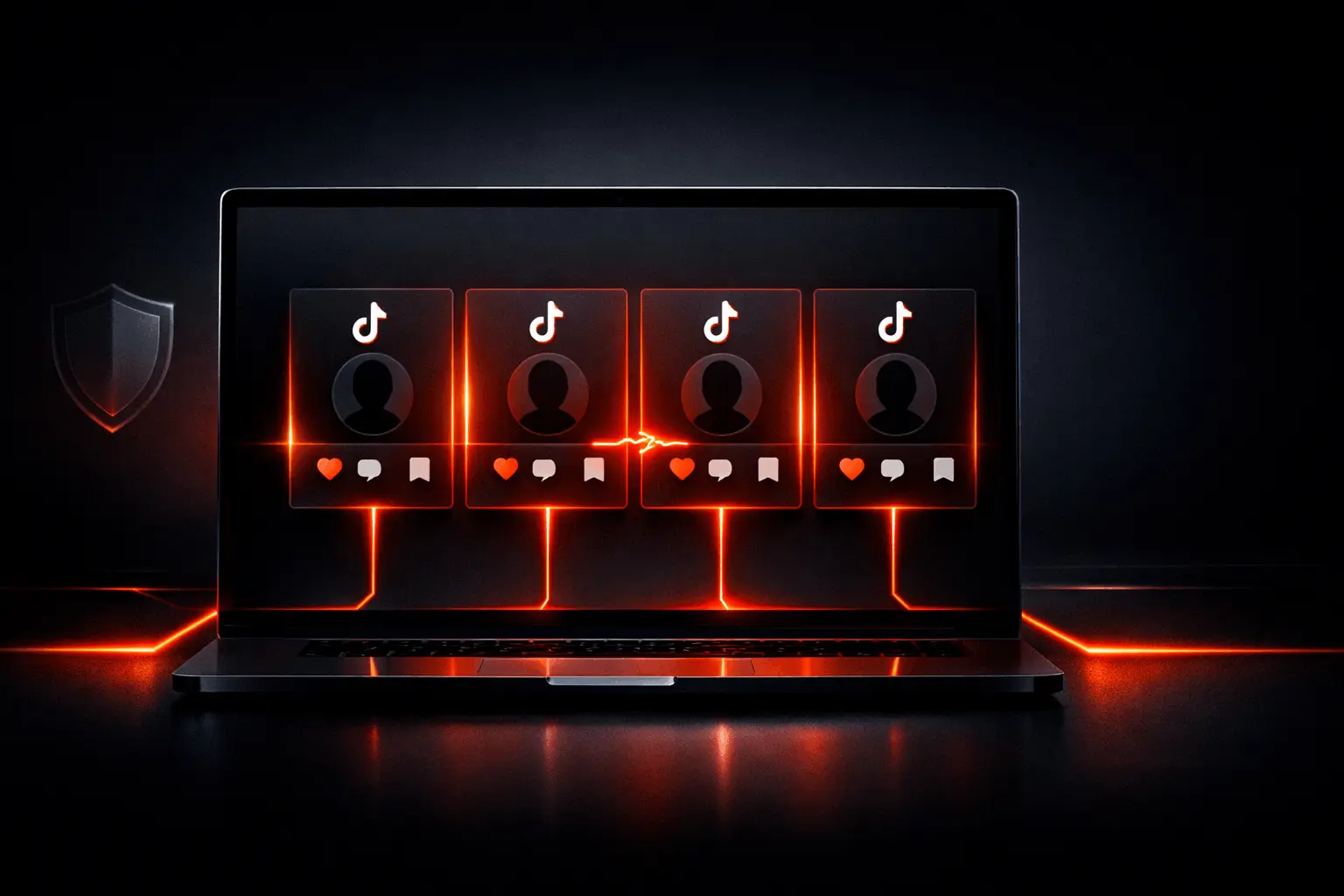
TikTok evaluates more than just your IP address. Getting the proxy right is step one. Behavioral signals, session stability, and account warming are what keep accounts alive.
- One proxy per account is non-negotiable. TikTok links accounts to IP addresses. Sharing one IP across multiple accounts is the fastest route to a mass ban.
- Residential and ISP static proxies outperform datacenter proxies on TikTok for anything requiring account longevity. Datacenter IPs are flagged too easily.
- Account warming takes 7 to 14 days. Run automation on a cold account and TikTok will flag it within hours. That is not a proxy problem. It is a sequencing problem.
- Scraping and account management are different jobs with different proxy requirements. Do not use the same setup for both.
TikTok has roughly 1.9 billion monthly active users as of early 2026. Indonesia leads with 180.1 million users, followed by the US at 136 million. The platform generated $33.1 billion in global advertising revenue in 2025, and TikTok Shop alone pulled in $15.82 billion in US sales. This is no longer just a content platform. It is a serious commerce and marketing channel, and serious operations need serious proxy infrastructure to run at scale.
This guide covers what TikTok proxies actually are, how TikTok's detection system works, which proxy type is right for which job, and what the account warming process looks like in practice. The real question is not just which proxies work. It is which proxies work for your specific use case on TikTok. Let's get into it.
What Is a TikTok Proxy?
A TikTok proxy is an intermediary IP address that sits between your device and TikTok's servers. When you connect through a proxy, TikTok sees the proxy's IP address and location, not yours. That is the basic function. The reason it matters for TikTok specifically is that the platform makes significant decisions based on your IP: what content it shows you, which regional features are available, whether your account gets flagged, and whether your requests look like a real person or a bot.
The practical uses split into three broad categories. The first is multi-account management, where agencies, marketers, and creators run multiple TikTok profiles simultaneously. TikTok limits new account creation and links accounts to IP addresses, so proxies are required to keep accounts isolated. The second is geo-targeting, where you need a specific country's IP to access regional content, test local ad placements, or trigger the correct For You Page algorithm. The third is data collection, where researchers and analytics teams scrape public TikTok data at scale without hitting rate limits or getting blocked.
Each of these use cases has different requirements. What works for scraping does not necessarily work for account management. That distinction matters more on TikTok than on most other platforms, and most guides do not make it clearly enough.
How TikTok's Detection System Actually Works in 2026
TikTok does not just check whether your IP is a datacenter IP. Its detection system evaluates multiple layers simultaneously, and understanding this changes how you approach proxy selection.
Layer 1: IP Reputation and Type
The first check is straightforward. Datacenter IP ranges are publicly documented and widely blocked. TikTok maintains its own blocklists of known datacenter subnets, shared proxy ranges, and IPs with prior abuse history on the platform. A clean residential or ISP IP passes this check. A datacenter IP from a known hosting provider often does not.
Mobile IPs benefit from an additional structural advantage. Most real TikTok users access the platform via mobile data. Mobile carriers use CGNAT (Carrier-Grade Network Address Translation), which means hundreds of real users can share a single IP address simultaneously. TikTok cannot easily ban a mobile carrier IP without blocking hundreds of legitimate users. That is why mobile proxies carry the highest trust score on TikTok. The platform is structurally reluctant to block them.
Layer 2: Behavioral Pattern Analysis
This is the layer most guides skip. Even with a clean residential IP, TikTok monitors behavioral signals: request frequency, navigation patterns, interaction timing, and consistency between actions. A real user does not follow 200 accounts in 45 seconds. An automated script often does. Behavioral anomalies trigger verification challenges and account flags regardless of IP quality.
In practice, what this means is that your proxy is the foundation, not the solution. A clean proxy with robotic behavior will still get flagged. The proxy reduces the IP-level detection risk. Behavioral hygiene handles the rest.
Layer 3: Device Fingerprint and Session Consistency
TikTok tracks device identifiers, browser fingerprints, and session patterns. If your proxy IP changes but your device fingerprint stays the same across ten different accounts, TikTok can still link those accounts. This is why pairing proxies with an antidetect browser is standard practice for multi-account management. The proxy handles IP isolation. The antidetect browser handles fingerprint isolation.
Which Proxy Type Works on TikTok in 2026
You have four options. They differ significantly in trust score, cost, and which use cases they are actually suited for. Here is the honest comparison.
| Proxy Type | Trust Score | Best For | Limitations | Verdict |
|---|---|---|---|---|
| Mobile (4G/5G) | Highest | Account management, creation at scale, platforms with strict detection | Most expensive per GB. Not ideal for large-volume scraping at reasonable cost. | Gold Standard |
| Hybrid / Plan X (ISP + Mobile + Residential) |
Very High | Multi-account management, automation at scale, TikTok data collection | Not a dedicated mobile proxy. Some high-friction targets may still prefer pure mobile. | Best Value |
| Residential | High | Geo-targeted browsing, scraping at moderate scale, account warming | Peer-to-peer sourcing means occasional lower-quality IPs in rotation. | Solid Choice |
| ISP Static | High | Long-term account management, accounts requiring consistent IP identity | Not suitable for scraping at scale. Fixed IP means no rotation diversity. | Best for Persistent Accounts |
| Datacenter | Low | Very light-touch, low-risk scraping in small bursts | Easily detected on TikTok. Subnets are widely documented and flagged. | Avoid for Accounts |
| Free Proxies | None | Nothing mission-critical | Already blacklisted on most social platforms. Risk of credential exposure. | Avoid Entirely |
The real decision is between hybrid and ISP static for most TikTok operations. Mobile proxies are technically superior but the cost per GB is prohibitive for anything beyond a few targeted accounts. A hybrid pool combining ISP, mobile, and residential sources gets you very close to the mobile trust floor without the mobile price tag. For accounts you plan to manage for months, ISP static proxies give you a fixed identity that TikTok learns to treat as a known, trusted device over time.
TikTok Scraping vs. Account Management: Different Jobs, Different Proxies
This is the part most guides treat as one category. It is not. Scraping and account management have fundamentally different proxy requirements, and mixing them up is how you burn through budget on the wrong setup.
From an operational perspective, I would not run account management and scraping through the same proxy pool. Cross-contamination is a real risk. If a scraping IP gets flagged for high-volume behavior, you do not want that flag spreading to your management pool. Keep them separate from the start.
The One-Proxy-Per-Account Setup
TikTok allows up to three accounts per device natively. For agencies managing more than three, proxies are not optional. The setup is straightforward in principle, but the details matter.
The Core Rule
One proxy per account. Not one proxy subnet per account. Not one proxy per device. One unique IP address assigned exclusively to one TikTok account, maintained consistently for the life of that account. TikTok's account linking detection is sensitive enough that reusing an IP even briefly across two accounts can establish a connection between them. Once that link exists, a ban on one account increases the risk for the other.
The most common setup mistake is using rotating residential proxies for long-term account management. Rotating proxies work by assigning a new IP for each request or session. This means every time you log back into an account, you are coming from a different IP address. TikTok interprets repeated logins from different IPs as suspicious access patterns.
Rotating proxies are the right tool for scraping. They are the wrong tool for accounts you want to keep alive for months. ISP static proxies or sticky residential sessions assigned consistently to each account are what you need for management.
Account Warming: The Step Most People Skip and Regret
This is the part most proxy guides skip over entirely, which is why so many people get their accounts banned immediately after setting up what looks like a technically correct proxy configuration. The proxy is fine. The account is not ready.
Account warming is the process of establishing a new TikTok account as a legitimate, human user before running any automation or high-volume activity. TikTok applies extra scrutiny to new accounts, particularly those that immediately engage in activities that look automated or commercial. A new account that immediately starts following 100 people and posting promotional content is going to get flagged, regardless of proxy quality.
A Realistic Warming Timeline
The honest limitation here: I cannot say with certainty that every account warmed over 14 days will survive automation at scale. TikTok's detection is continuously updated, and what worked six months ago may need adjustment. I have seen well-warmed accounts get flagged and poorly-warmed accounts survive longer than expected. The warming process reduces risk significantly, but it does not eliminate it. Build your workflow assuming a portion of accounts will need to be replaced regardless.
TikTok Proxy Considerations for Key Markets in 2026
The markets where TorchProxies operates most heavily have specific characteristics that affect how you should configure your TikTok proxy setup. TikTok's content algorithm, Shop availability, and detection behavior all vary by region.
| Market | TikTok Users | Key Proxy Use Case | Notes |
|---|---|---|---|
| United States | 136 million MAU | TikTok Shop intel, ad verification, account management for US-targeted creators | Highest ad CPM globally. US IPs required to access TikTok Shop affiliate features. State-level targeting available on select plans. |
| Indonesia | 180.1 million MAU | Largest TikTok market. Scraping trending regional content, local brand monitoring | Highest user count globally. TikTok Shop launched early in Indonesia. Strong local creator economy to monitor. |
| United Kingdom | ~23 million MAU | TikTok Shop UK (launched 2023), influencer research, ad placement verification | TikTok Shop UK is a high-growth market. UK IPs needed for localized Shop browsing and ad verification workflows. |
| Germany | ~21 million MAU | EU content compliance testing, geo-targeted ad verification, regional scraping | GDPR-specific content variations require EU IPs. German residential IPs for precise local content testing. |
| Japan | ~17 million MAU | J-pop trend tracking, brand marketing research, Popmart/Pokemon Center cross-platform intelligence | Japanese TikTok has distinct trending content. Useful for brands operating in both TikTok and retail spaces simultaneously. |
| South Korea | ~11 million MAU | K-pop trend monitoring, fashion and beauty brand intelligence | High-value content vertical. Korean IPs unlock regionally specific For You Page content relevant to beauty and entertainment brands. |
| India | TikTok banned | Not applicable for TikTok operations | TikTok has been banned in India since 2020. Indian proxies are not useful for TikTok access. Relevant for other platforms only. |
| Canada / Netherlands / Hong Kong | Moderate markets | Regional ad testing, geo-targeted content monitoring | Useful for verifying international campaign placements and testing content availability across regions. City-level targeting available on supported plans. |
Worth stating clearly: India is not a TikTok market. TikTok has been banned there since 2020. If you have Indian audience targets, other platforms are the relevant focus. This is the part most TikTok proxy guides do not bother to note because it reduces the number of recommended use cases. But it is accurate, and knowing it saves wasted setup effort.
When You Do Not Actually Need a TikTok Proxy
Honestly, I would not overthink this. There are real use cases where a proxy is the right answer, and there are situations where it adds complexity without solving an actual problem.
You do not need a proxy if you are running a single TikTok account from your own location, posting content manually, and not doing anything that requires a different IP. TikTok does not flag single accounts for using their real home IP address. A proxy adds no value here.
You do not need a proxy if you are using TikTok's official API for data access. ByteDance provides a Research API for qualified organizations. If your use case fits the eligibility criteria, the official API is the cleaner path. It does not require proxy management, and the data access is explicitly permitted by the platform.
You do not need a proxy if your geo-testing needs are casual and infrequent. A VPN is simpler to manage for a one-time check of how a specific country's TikTok looks. Proxies are the right tool when you need per-account isolation at scale, programmatic access, or sustained multi-region operations. For a single check, a VPN is sufficient.
The real question is whether your operation requires IP isolation, regional targeting at scale, or programmatic data access. If the answer to any of those is yes, proxies are the right infrastructure. If the answer is no, you may be adding complexity you do not need.
Common TikTok Proxy Mistakes That Kill Accounts
Which TorchProxies Plan for TikTok Operations
The plan selection follows directly from the use case. There is not a single right answer for everyone. Here is how to match them.
| Use Case | Recommended Plan | Why | Price |
|---|---|---|---|
| Long-term account management (holding accounts for months) | ISP Static Proxies Fixed IP, SOCKS5 |
Same IP for the life of the account. TikTok builds a consistent location history. Supports SOCKS5 and HTTPS with switchable authentication. No IP changes between sessions. The right tool for account longevity. | $2.3/IP |
| Multi-account creation, Telegram bot integration, high-protection social targets | Plan X (Hybrid) 120M+ IPs, ISP + Mobile + Residential |
Combines ISP, mobile, and residential sources in one pool. Highest success rate on platforms with advanced detection. 99% uptime. 180+ countries. The closest thing to mobile-grade trust without the mobile price tag. Confirmed use case: a TorchProxies Trustpilot reviewer based in India rated it superfast and high quality for bot use. | $5/GB |
| TikTok scraping, market research, TikTok Shop data collection at volume | Premium Residential 90M+ premium IPs |
90M+ high-quality residential IPs. Better success rates than Standard for platforms applying IP reputation scoring. Suitable for sustained scraping operations without rate limits. | $4.5/GB |
| Light-touch geo-testing, content sampling across regions, small-scale scraping | Standard Residential 30M+ IPs, 195 countries |
30M+ IPs across 195 countries. Pay-as-you-go with no rate limits. Sufficient for general scraping and geo-targeted browsing at moderate scale. Free trial available with no credit card required. | $4/GB |
All plans are pay-as-you-go with no contracts and no rate limits. City-level targeting is available for US and international on select pools. The honest limitation: even in a large pool, rotation can occasionally serve a lower-quality address. This is rare, but worth building retry logic around for any TikTok workflow where account health is critical. Not every IP in a pool of millions will have a perfect trust score on every platform.
I will not go deep on antidetect browser setup here because it deserves its own guide. Pairing your proxies with Multilogin or GoLogin is a separate technical topic with enough complexity to warrant dedicated coverage.
The Bottom Line
TikTok's detection system is multi-layered. Proxy type is one layer. Behavioral patterns, device fingerprinting, and session consistency are the others. Getting the proxy right is the foundation. It is not the whole answer.
The practical framework: ISP static proxies for accounts you want to keep for months. Plan X hybrid for multi-account creation and automation where you need high trust scores at volume. Rotating residential for scraping and data collection. Never share IPs across accounts. Always warm accounts before automation. Always pair with an antidetect browser for multi-account work.
The market context matters too. The US, Indonesia, UK, Germany, Japan, Korea, Canada, Netherlands, and Hong Kong are all valid TikTok proxy markets for different reasons. India is not, because TikTok is banned there. Knowing which market you are actually targeting before you build your proxy configuration saves wasted effort.