



























.svg)
.svg)
.svg)
Mobile Proxies vs ISP Proxies:
The Honest Decision Guide
ISP proxies fake ASN legitimacy on top of real datacenter speed. Mobile proxies borrow real carrier legitimacy and get their protection from CGNAT sharing. Here's tested pricing, speed, and ban-resistance data for both, so you can match the right one to your workload instead of guessing.
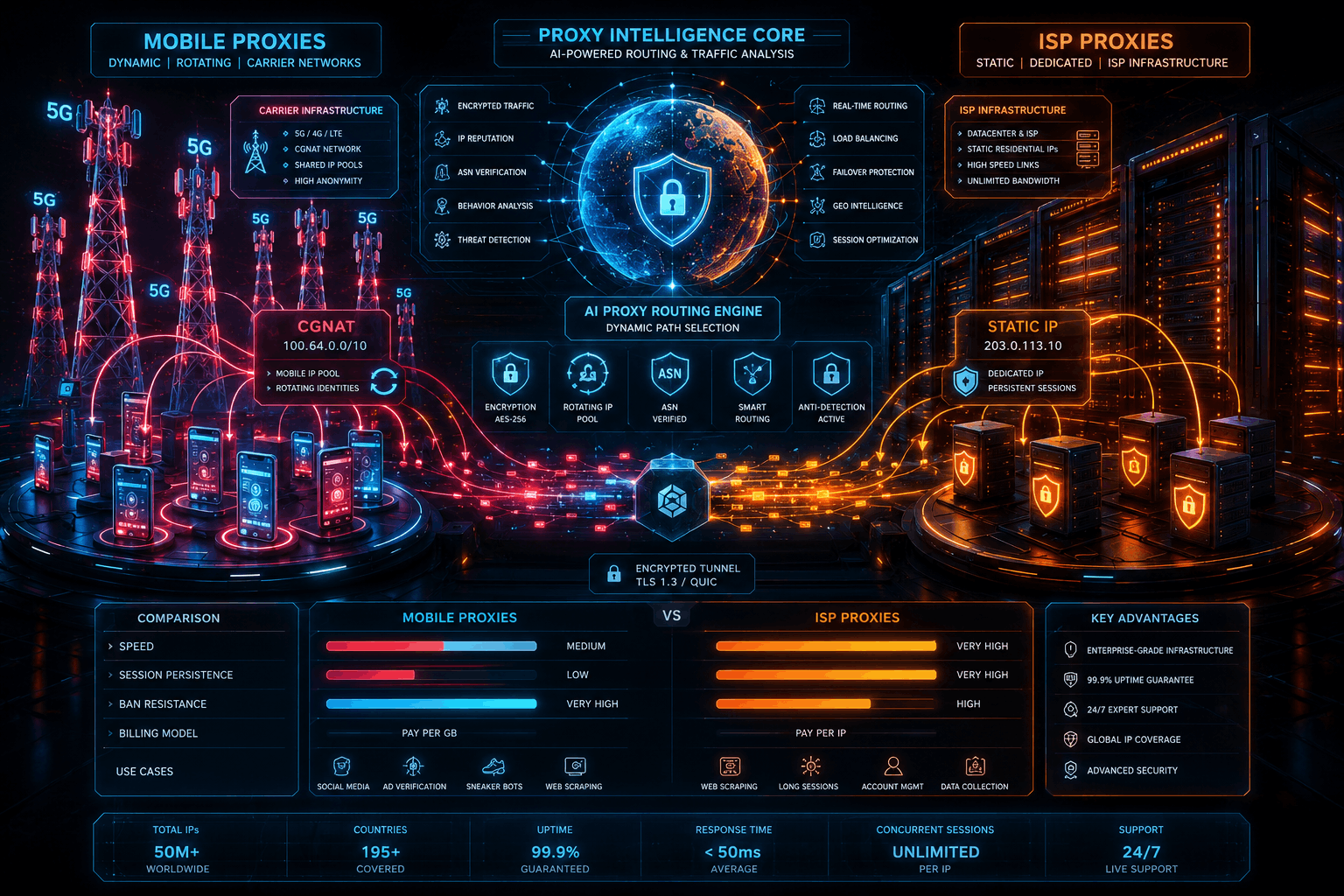
- ISP and mobile proxies use different billing models entirely. ISP proxies are typically priced per IP per month ($0.30 to $3.20+ depending on provider and volume), while mobile proxies are priced per GB ($30/GB at entry, dropping to about $2.48/GB at the 500GB tier). Comparing sticker prices directly is misleading unless you normalize for actual usage.
- Independent testing found ISP proxy success rates from about 94.75% to 100% across seven providers, with response times as fast as 0.18 seconds (Proxyway, "11 Best ISP Proxies," Feb 17, 2026).
- ISP proxies are static by default (the same IP for weeks or months), while mobile proxies are typically sticky for 10-30 minutes or rotate per request. That structural difference, not raw speed, decides which use cases fit which proxy type.
- Neither proxy type is bulletproof. ISP proxies can be flagged when ASN-type checks contradict hosting-provider fingerprints; mobile proxies depend on real carrier conditions that ISP infrastructure never has to deal with.
Bot traffic made up 53% of all web requests in 2025, and 40% of that was classified malicious, both figures up from the year before (Thales/Imperva, 2026 Bad Bot Report, Apr 29, 2026). Every proxy buyer is now shopping in a market where the target platforms assume most non-human traffic is hostile by default. That makes the proxy type behind a request matter as much as the proxy itself.
Mobile and ISP proxies solve the detection problem in almost opposite ways. Mobile proxies borrow legitimacy from a real carrier network. ISP proxies borrow legitimacy from a real ISP's IP registration while running on datacenter hardware. This guide compares what each actually is, how they're priced, how fast they run, and which jobs each one is built for, using independently tested data wherever it exists and flagging vendor claims where it doesn't.
Quick Comparison
| Category | ISP Proxies | Mobile Proxies |
|---|---|---|
| IP Source | Leased from real ISPs, hosted on datacenter servers | Real carrier-assigned IPs on cellular networks |
| Billing Model | Per IP, per month | Per GB |
| Entry Pricing (2026) | ~$0.30-$3.20/IP | $30/GB median |
| Session Type | Static - same IP for weeks/months | Sticky (10-30 min) or full rotation per request |
| Tested Success Rate | 94.75%-100% across 7 providers | Not independently benchmarked at this granularity |
| Tested Response Time | 0.18-0.67s | Slower, subject to real carrier congestion |
| Ban Resistance Mechanism | Dedicated IP, no shared blast radius, but ASN-type checks can flag it | CGNAT sharing across dozens of real subscribers |
| Best For | Account management, ad verification, SEO tracking | Carrier/app-layer fingerprint evasion, TikTok/Instagram automation |
| Our Verdict | Win: speed, cost predictability, session persistence | Win: structural ban resistance for app-tied workloads |
What Is an ISP Proxy, Actually?
That's structurally different from both proxy types it's often confused with. Residential proxies are peer-sourced from real consumer devices and connections, with all the bandwidth variability that implies. Mobile proxies are peer-sourced too, but specifically from cellular devices sitting behind carrier-grade NAT. ISP proxies skip the peer-sourcing step entirely. There's no home router, no real end-user device, and no CGNAT sharing, just a commercially leased IP block sitting in a datacenter.
Static vs. Rotating Changes Which Jobs Each Type Can Do
ISP proxies default to static. Mobile proxies default to rotating or short sticky sessions. That single difference decides more use-case fit than pricing or raw speed.
An ISP proxy typically holds the same IP for weeks or months until you manually rotate it. A mobile proxy is usually sticky for a short session window, often 10 to 30 minutes, or set to rotate on every request from the provider's device pool (Bright Data, "Static vs Rotating Proxies", 2026). Platforms that track IP-consistency patterns over time, like login systems watching for a stable device-and-location fingerprint, reward the static approach. Platforms and tasks where a fresh identity per attempt matters more than tenure reward rotation instead.
Account management and multi-account operation, ad verification, and SEO rank tracking all lean on the same account or device profile looking stable over time, which is why static ISP IPs fit them well. Sneaker copping and TikTok or Instagram automation often lean the other way, needing a fresh identity per attempt more than a persistent one.
Speed and Uptime: Datacenter Infrastructure Has a Real Edge
ISP proxies win here, and the reason is structural: they run on datacenter hardware instead of a real cellular connection.
Proxyway's February 2026 benchmark tested 100 US ISP IPs across seven providers, sending 70,000 requests over seven days to the nearest global CDN node. Results ranged from a low of IPRoyal at 94.75% success and 0.46s average response time, up through Webshare at 98.27% and 0.42s, Proxy-Seller above 90% at 0.67s, Oxylabs at 99.98% with a 0.18s response time, and Decodo and NetNut at 100% success with response times of 0.21-0.22s; Bright Data's success rate wasn't published in the same table (Proxyway, "11 Best ISP Proxies," Feb 17, 2026). Torch Proxies' own ISP network averages a self-reported 0.2s response time, in the same range as the fastest providers Proxyway tested independently, though that figure comes from our own monitoring rather than the Proxyway study itself. Mobile proxies don't have an equivalent independent benchmark at this granularity. The structural reason for a speed gap is straightforward: a datacenter server has a fixed, high-bandwidth backbone connection, while a mobile proxy rides an actual phone's real-world signal strength, tower congestion, and carrier throttling. Some proxy vendors report mobile 5G connections averaging around 145ms latency versus roughly 10-50ms for datacenter-hosted ISP proxies. Those specific figures come from vendor blogs rather than an independent lab, so treat them as directional rather than benchmark-grade (Coronium, "Static Residential IP Proxy vs Residential Proxy", updated Mar 30, 2026).
Ban Resistance Works Differently for Each Type
Mobile still has the structural ban-resistance edge for anything tied to an account, but ISP proxies aren't defenseless, and the mechanism matters more than which one "wins."
Mobile's resistance comes from that sharing: a platform that bans the IP outright risks blocking legitimate paying customers along with the automated traffic, which makes platforms reluctant to hard-block mobile ranges. ISP proxies work the opposite way. Because the IP is dedicated to one renter (when it's genuinely dedicated, per the buyer-beware note above), a ban hits only that one account with no shared pool absorbing the reputational risk. The upside is that ISP IPs don't inherit anyone else's bad behavior. The downside is a ban lands squarely on you.
Detection systems specifically watch for the mismatch ISP proxies are built to hide. ASN records say "ISP," but hosting-provider fingerprints (open ports typical of datacenter subnets, no consumer-modem signatures, geolocation assigned virtually rather than tied to a real physical connection) can still give away a datacenter-hosted IP wearing an ISP registration (ASN and WHOIS lookup documentation via ipapi.is; LiveProxies, "Enhancing Proxy Workflows With IP Intelligence"). Proxyway's own 2026 research flags the same virtual-geolocation gap as a detectable signal.
Pricing: Two Different Billing Models, Not Just Two Different Prices
Neither type "wins" on price in the way that comparison usually gets framed, because they're not billed the same way at all.
ISP proxies are typically sold per IP per month (or per day), not per GB. Proxyway's tested pricing ranged from Webshare at $0.30/IP up to Oxylabs at $3.20/IP at small test volume, with Bright Data around $1.80/IP and Decodo split between $0.47/IP shared and $3.33/IP dedicated (Proxyway, "11 Best ISP Proxies," Feb 17, 2026). Oxylabs' own published pricing, which assumes bulk purchase, quotes shared ISP proxies from $1.60/IP and dedicated from $2.10/IP with a 5-IP minimum (Oxylabs pricing), a reminder that "from" prices on vendor pages assume volume discounts you may not hit right away. Mobile proxies, by contrast, are billed per GB: $30/GB at entry, dropping to $2.48/GB at the 500GB tier per the same benchmark series covering both categories.
IP Pool Size and Availability
ISP proxy pools are smaller than they sound on a sales page, and mobile proxy pools have the same problem for a different reason.
Proxyway's testing found real, active pool sizes well below what some providers advertise: NetNut at 1M+ static IPs (mostly US), Bright Data around 700K, IPRoyal at 500K, Webshare at 100K+, and Decodo at roughly 13,000 IPs across multiple countries, a fraction of the "millions" some marketing pages imply. Proxyway itself calls out providers advertising figures like 10 million ISP IPs when only around 500,000 are actually active (Proxyway, "11 Best ISP Proxies," Feb 17, 2026). Mobile pools face a structural ceiling for a different reason: they're limited by how many real devices a provider can route through, which independent testing put at roughly 1.19 million unique IPs against a 16 million advertised median in the same benchmark series covering mobile.
Matching Proxy Type to the Job
Different jobs reward different proxy types. This is the part of the decision that pricing spreadsheets tend to miss.
| Use Case | Recommended | Notes |
|---|---|---|
| Account management / multi-accounting | ISP | Static IP looks like normal, stable usage. |
| Ad verification | ISP | Fast, stable, dedicated IPs beat rotating mobile bandwidth. |
| SEO rank tracking, SERP monitoring | ISP | Predictable per-IP billing fits repeated, predictable querying. |
| Streaming access | ISP | Static, high-uptime IP suits long sessions. |
| Web scraping at scale | Depends | Residential usually cheaper for pure volume. |
| Sneaker / limited-release copping | Depends | Mobile blends in; ISP works if speed matters more than identity-per-attempt. |
| TikTok / Instagram automation | Mobile | Fingerprints at the carrier and device layer, not just ASN. |
| SMS / phone-number-linked verification | Mobile | Requires a real cellular connection, not an ASN registration. |
Account management, ad verification, and SEO tracking reward the static, high-speed profile ISP proxies are built for. TikTok and Instagram automation, along with any workflow tied to SMS or phone-number verification, generally require mobile, because those platforms fingerprint at the carrier and device layer in ways an ASN registration alone can't fake. Proxy-industry blogs describing TikTok's detection stack consistently mention IP-reputation checks layered with device and behavioral fingerprinting, though TikTok doesn't publish its detection methodology, so treat that as informed industry consensus rather than confirmed platform policy (Multilogin, "Best Mobile Proxies", 2026). Web scraping at scale and sneaker copping fall into "depends": scraping is usually better served by residential proxies for volume and cost (see our mobile vs residential proxies comparison for that breakdown).
Who Should Choose What
Verdict: Category Winners
| Category | Winner |
|---|---|
| Speed / Response Time (tested) | ISP |
| Session Persistence | ISP |
| Pricing Predictability | ISP (per-IP, easier to budget) |
| Structural Ban Resistance (account-tied) | Mobile |
| IP Pool Depth vs. Advertised Claims | Tie (both overstate) |
| Overall | ISP for speed, cost predictability, and session-based work; mobile for carrier- and app-layer evasion |
There's no single winner because the two proxy types are built for different threats. ISP proxies fake ASN legitimacy on top of real datacenter speed. Mobile proxies borrow real carrier legitimacy and get their protection from CGNAT sharing. The right call depends on whether the platform you're working against checks ASN type and IP consistency, or checks carrier and device signals directly.
Summary
Torch Proxies runs residential and ISP proxy plans today; mobile is on our roadmap but not live yet, so if your workload is genuinely mobile-only, keep that in mind while comparing providers. For the full walkthrough of where residential fits into this picture too, see our mobile vs residential proxies comparison or the complete guide to proxies for web scraping. Not sure ISP is the right shape of proxy for your use case at all? See our breakdown of static vs. rotating proxies first.