

























.svg)
.svg)
.svg)
No-Code Web Scraping with
Proxies Using n8n
A step-by-step guide to building a proxy-powered scraping workflow in n8n from three core nodes: HTTP Request, HTML, and Loop Over Items, no code required.
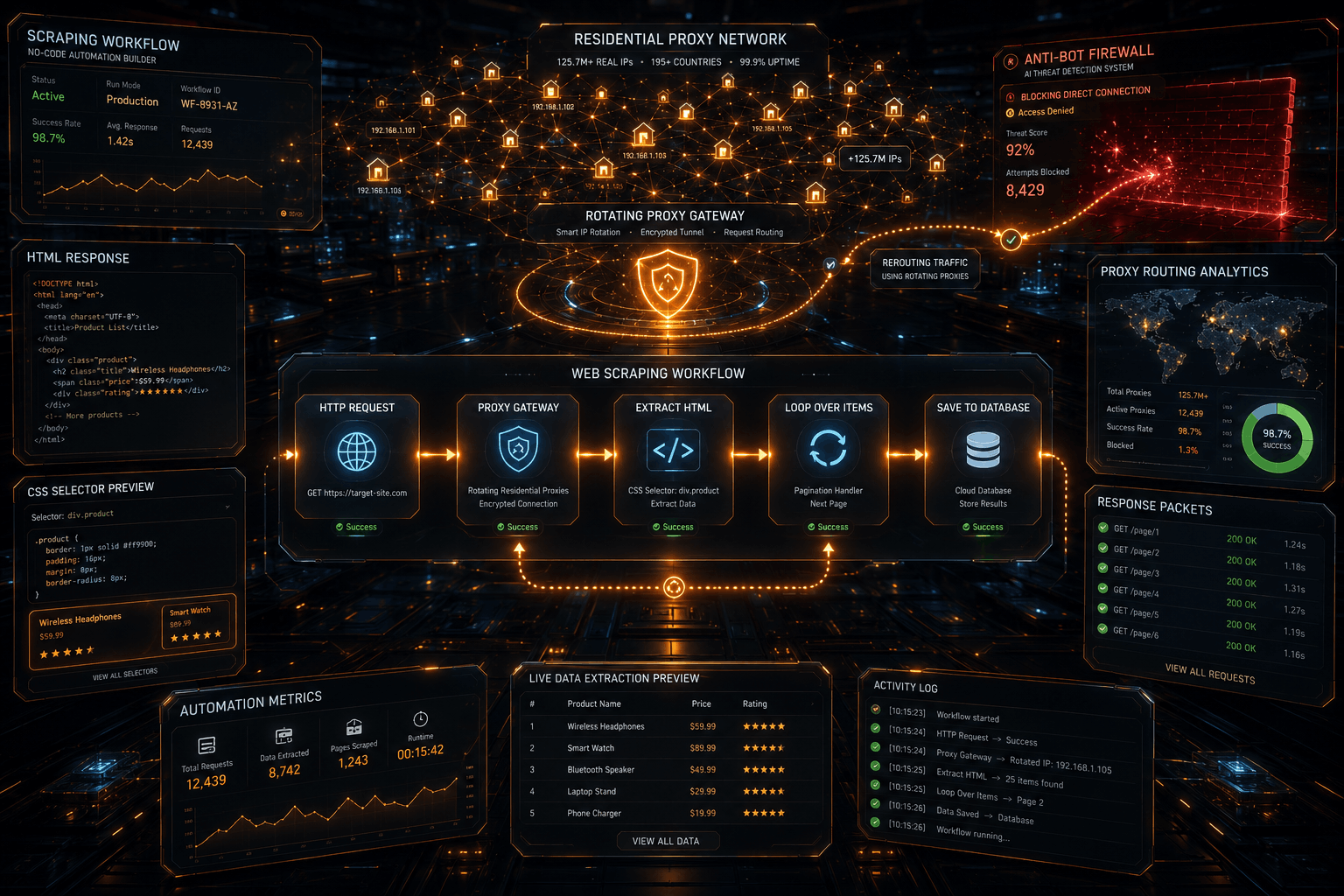
- The HTTP Request node has a native Proxy field that accepts a full URL with embedded credentials. No plugin needed.
- Bot traffic was 53% of the web in 2025, and 40% of it was flagged "bad" (up from 37% the year before), which is why proxy-free scraping breaks faster than it used to (Imperva/Thales 2026 Bad Bot Report).
- Three nodes cover most scraping jobs: HTTP Request, HTML, Loop Over Items. JavaScript-rendered pages need Firecrawl or ScrapeNinja instead.
- Gartner expects 70%+ of new enterprise apps to run on low-code/no-code tools by 2026, up from under 25% in 2023.
- Scraping public data isn't a CFAA violation after hiQ v. LinkedIn. Breaking a site's Terms of Service while doing it is still a separate legal problem.
Why n8n Instead of a Script
A workflow you can look at beats a script only one person understands. When the target site changes its markup, and it will, a visual node chain is easier for someone non-technical to fix than a buried CSS selector in a Python file.
n8n isn't a side project anymore. The company closed a $180 million Series C in October 2025 at a $2.5 billion valuation, led by Accel, and reported 6x user growth the year before that (n8n, Oct 2025). Its GitHub repo has cleared 198,000 stars (GitHub, retrieved Jul 2026). That tracks with Gartner's broader low-code forecast: the market hits roughly $44.5 billion in 2026, with 80%+ of low-code users sitting outside formal IT departments, up from 60% in 2021 (Gartner, via ToolJet). Scraping fits that shift cleanly. Fetch, extract, loop, store. It's node work, not engineering.
None of that makes it easier in every sense. You trade code-level control for a canvas you can read at a glance, and you still hit the same wall every scraper hits eventually: getting blocked.
Why Skipping the Proxy Backfires
A scraper without a proxy fetches ten or twenty pages fine, then starts getting 403s. Not because the workflow is broken. Because the site's anti-bot system scored the IP as automated and shut it out.
Bot traffic made up 53% of all web traffic in 2025. "Bad" bots, the ones anti-bot systems actively try to block, rose to 40%. That's the seventh straight year that share has grown, up from 37% the year before (Imperva/Thales 2026 Bad Bot Report). The same report tracked 17.2 trillion bot requests and found daily blocked AI-driven attacks jumped from roughly 2 million to 25 million. Scraping alone accounts for around 31% of the API-layer attacks anti-bot systems flag (DeepStrike, citing Imperva).
IP reputation is one of the main signals anti-bot systems score, alongside device fingerprinting and behavior. A datacenter IP firing off dozens of sequential requests looks nothing like a real visitor. A rotating residential or ISP proxy won't dodge every block, but it removes the single easiest tell. For more on the mechanics, see our complete guide to proxies for web scraping.
The Nodes You'll Actually Use
| Node | Job | Proxy Support |
|---|---|---|
| HTTP Request | Fetches the raw page | Native Proxy field per request |
| HTML | Extracts data by CSS selector (replaced "HTML Extract" as of v0.213.0) | N/A, works on already-fetched HTML |
| Loop Over Items (Split in Batches) | Pages through results until a stop condition fires | N/A, controls flow |
| Firecrawl / ScrapeNinja (community) | Renders JS and rotates proxies in one call | Built into the node |
n8n's own docs describe the HTTP Request node's proxy option as taking "precedence over global settings defined with the HTTP_PROXY, HTTPS_PROXY, or ALL_PROXY environment variables" (n8n Docs). Self-hosting n8n? Set those same env vars globally and every node's traffic routes through the proxy without touching individual nodes (n8n Docs).
Build the Scraper: Five Steps
Trigger, fetch, extract, loop, store. That's the whole workflow.
Add a Trigger
Configure the HTTP Request Node's Proxy
GET, and add a realistic User-Agent header so the request doesn't look like a bare script.http://username:[email protected]:PORT
Extract With the HTML Node
.product-title, .price, a.next-page. Whatever the page's markup actually uses. Each match comes back as a structured field.Loop for Pagination
Store Results and Catch Failures
When Core Nodes Aren't Enough
If the target renders with JavaScript, don't force it. HTTP Request and HTML fetch and parse static markup. Neither runs a browser.
n8n has no built-in Selenium-style node. Two community options fill the gap. Firecrawl is now a native n8n Cloud integration that scrapes, crawls, and converts full sites to markdown with JS rendering handled for you (Firecrawl). ScrapeNinja (n8n-nodes-scrapeninja) is an official community node built specifically around rotating proxies and real-browser rendering, live on n8n's own community forum since February 2025 (n8n Community). Both install from Settings → Community Nodes and drop into the same trigger-fetch-store shape, just replacing HTTP Request and HTML with one node.
That's also the direction the market is heading. Web scraping software is projected to go from $0.99 billion in 2025 to $1.17 billion in 2026, and $2.23 billion by 2031 (Mordor Intelligence). A good chunk of that growth is exactly this: managed scraping infrastructure with proxies and rendering baked in, instead of hand-rolled HTTP requests.
Picking a Proxy Type
Match the proxy to the job. Get this wrong and you either overpay or get blocked faster than the workflow can recover.
High-volume, price-sensitive scraping (listings, SERP checks, market research) wants residential proxies: bigger tested pools, lower cost per GB. See our residential vs. mobile comparison for the pool-size and ban-resistance detail. Work that needs a stable identity (logged-in sessions, account-bound dashboards) wants an ISP proxy instead: a static, dedicated IP rather than a rotating one. Not sure which fits? Our static vs. rotating breakdown covers it. Switching later just means editing one field, not rebuilding anything.
http://user:pass@gateway:port format n8n already expects. No adapter layer, no extra setup.
Is This Legal?
General education here, not legal advice. Short version: scraping public data isn't a CFAA problem, but breaking a site's Terms of Service while doing it can still land you in civil court.
hiQ Labs v. LinkedIn
hiQ still lost the bigger fight. A separate ruling found it breached LinkedIn's User Agreement, a contract claim, and the case closed with a confidential settlement (Apify). Winning on CFAA doesn't erase Terms of Service exposure.
What People Actually Build With This
Price and inventory monitoring. Lead generation from public directories into a CRM. SEO rank tracking without a paid subscription. News aggregation across sources. Hiring-trend research. Same three-node pattern underneath all of it, just a different proxy strategy: a weekly SERP check runs fine on a lighter setup than an hourly price monitor hitting the same retailer.
For a broader read on whether proxies are worth the spend for a given job, see do proxies still matter in 2026. And Gartner's low-code forecast, 70%+ of new enterprise apps by 2026, up from under 25% in 2023, is why so much of this guide is configuration rather than code (Gartner, via ToolJet).
Ready to test this on a real target? Compare TorchProxies' residential and ISP plans, drop the gateway credentials into your HTTP Request node's Proxy field, and run a small batch before scaling up.
Frequently Asked Questions
Conclusion
For the proxy side of that setup, our complete guide to proxies for web scraping goes deeper on rotation strategy once the workflow is live.