


























.svg)
.svg)
.svg)
Web Scraping Python vs PHP:
Which One to Pick?
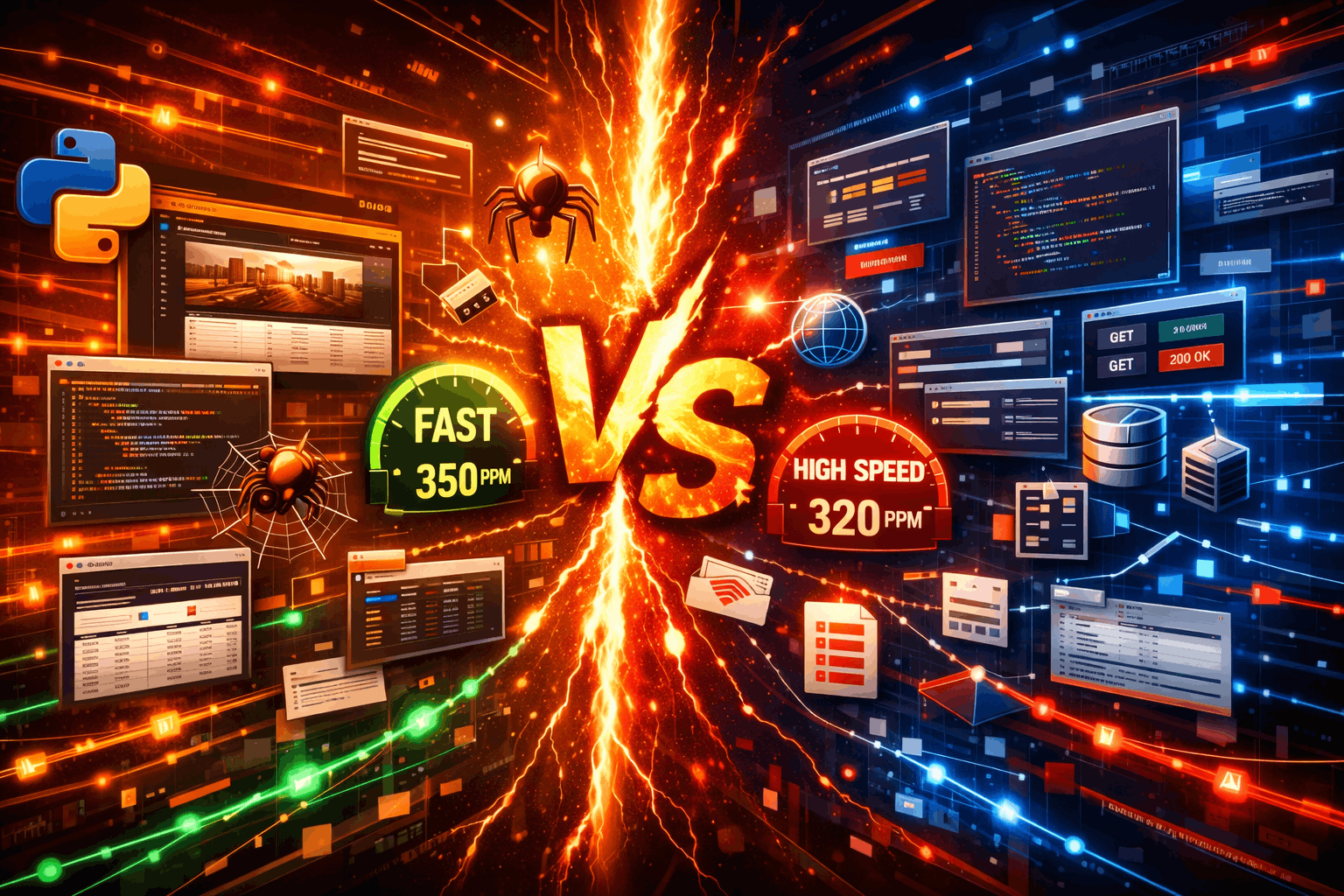
The short answer is Python. The useful answer is more complicated than that.
- Python dominates web scraping. Around 70% of web scraping projects use Python, per DataDwip's 2025 statistics report. The library ecosystem, particularly Scrapy and Playwright, is simply more mature.
- PHP has a real use case. If you already run a PHP backend and need light scraping integrated directly into the application, adding Python infrastructure is overhead you may not need.
- PHP is marginally faster on simple tasks. Bright Data's September 2025 benchmark recorded PHP at 10.33 seconds vs Python at 11.104 seconds on basic HTTP scraping. The gap reverses on JavaScript-heavy targets.
- Goutte is deprecated. Stop recommending it. The Goutte PHP scraping library was deprecated April 1, 2023. Most guides still list it without that note.
- The hybrid pattern solves the hardest cases. PHP teams facing complex scraping requirements can route jobs through a Python microservice without rebuilding their stack.
I have maintained scrapers in both languages on the same team. The Python ones got new libraries and community support every six months. The PHP ones were still relying on Goutte, which was deprecated in April 2023, because nobody had updated them. The thing is, PHP scrapers work fine until they do not, and when they stop working you have fewer options.
This guide covers the library ecosystems for both languages, verified performance data, proxy configuration code you can actually copy into a project, and a decision matrix so you can make the call cleanly for your situation. Let's get into it.
Python for Web Scraping
Python is a high-level, general-purpose language released in 1991 by Guido van Rossum. Currently at Python 3.13, released October 2024. Source: python.org. It became the default language for web scraping not because it is the fastest or the most tightly integrated with web infrastructure, but because its library ecosystem for data extraction, parsing, and browser automation is deeper and more actively maintained than any alternative.
According to DataDwip's 2025 web scraping statistics report, approximately 70% of web scraping projects use Python. That dominance is driven almost entirely by the library situation.
Python Scraping Libraries
requests fetches pages over HTTP. BeautifulSoup4 parses the HTML with CSS selectors or tag traversal. Works for static, non-JavaScript sites. Used by 43.5% of scraping projects.- httpx: async HTTP client, the modern alternative to
requestsfor async workflows - Selenium: older browser automation with broad legacy support, slower than Playwright
- Crawlee: newer framework from Apify, used by 34.8% of projects in DataDwip's survey
What this actually means in practice: you can start with requests and BeautifulSoup for a simple project, scale to Scrapy when you need async crawling at volume, and drop in Playwright when your targets start rendering content in JavaScript. Each tool layer is well-documented, has an active community, and integrates with the next.
PHP for Web Scraping
PHP is a server-side scripting language built for the web, first released in 1994. PHP 8.3 is the current stable release as of November 2023, with PHP 8.4 entering release candidate phase. Source: php.net. It powers the majority of websites on the internet. Over 75% of sites use it, according to W3Techs' technology usage statistics (updated monthly).
PHP was not designed for scraping. It was designed for generating dynamic web pages and interacting with databases. That origin shapes its scraping toolkit: most of its HTTP and HTML tools are built-ins that happen to be usable for extraction, rather than purpose-built scraping frameworks. That said, the ecosystem has improved meaningfully in the past few years with tools like Roach PHP and Guzzle.
Symfony\Component\BrowserKit\HttpBrowser directly, not the Goutte wrapper. Source: confirmed across the official Goutte GitHub repository and Symfony changelog.
PHP Scraping Tools
cURL handles HTTP requests at a low level. DOMDocument with DOMXPath parses the returned HTML. Verbose but reliable.- Roach PHP: Scrapy-inspired full crawling framework for PHP, released 2022. Actively maintained but with a smaller community than Scrapy.
- Simple HTML DOM: lightweight CSS selector parser, good for beginner projects with simple targets
- DiDOM: fast HTML/XML parser using DOMDocument under the hood, cleaner API
Python vs PHP: Feature-by-Feature Comparison
| Feature | Python | PHP |
|---|---|---|
| Ease of learning | Very easy. Clean syntax, beginner-friendly, strong educational resources. | Medium. C/Perl-influenced syntax, more verbose, steeper curve for beginners. |
| Scraping library ecosystem | Extensive Scrapy, Playwright, Requests, BeautifulSoup, httpx, Crawlee | Functional Guzzle, DomCrawler, Panther, Roach PHP, DiDOM |
| JavaScript rendering | Playwright and Selenium. Mature, widely documented, strong anti-detection community | Symfony Panther. Functional but smaller community, limited anti-detection tooling |
| Large-scale crawling | Scrapy. Async, pipeline architecture, battle-tested at millions of pages | Roach PHP. Scrapy-inspired, newer, smaller community and middleware ecosystem |
| Performance (simple scraping) | 11.104s average (Bright Data benchmark, September 2025) | 10.33s average. PHP slightly faster on basic HTTP tasks |
| Async support | Native asyncio, aiohttp, Scrapy's Twisted reactor | Guzzle promises, ReactPHP. Viable but less idiomatic |
| Proxy integration | requests proxies dict, Scrapy middleware, httpx proxy param | cURL CURLOPT_PROXY, Guzzle proxy option. Both straightforward |
| Community for scraping | Large and active. Stack Overflow, GitHub, dedicated Discord servers | Smaller scraping community; broader PHP web dev community but less scraping focus |
Performance: What the Data Actually Shows
Bright Data's September 2025 benchmark tested basic static-page HTTP scraping and found PHP averaging 10.33 seconds versus Python's 11.104 seconds. PHP was consistently faster on simple tasks.
That result flips on JavaScript-heavy targets. Python's Playwright is a more mature tool than Symfony Panther with better async architecture, more active anti-bot evasion research, and a larger community debugging edge cases. For async large-scale crawling, Scrapy's Twisted event loop is decades of battle-testing that Roach PHP has not yet replicated.
Honestly, this is simpler than it sounds: PHP is faster at the thing scraping rarely bottlenecks on (raw HTTP request time), and slower at the things that actually determine whether a large-scale scraper succeeds (async architecture, browser automation quality, anti-bot evasion).
Proxy Configuration: Python and PHP Side by Side
This is the section most guides skip entirely. How you route proxy credentials differs between Python and PHP, and getting it wrong means your scraper either leaks your real IP or silently fails with auth errors. Here is the working configuration for both languages.
Python Proxy Configuration
With requests, the simplest pattern, works for any static target:
import requests

proxies = {
    "http":  "http://USERNAME:[email protected]:31112",
    "https": "http://USERNAME:[email protected]:31112",
}

response = requests.get("https://target.com", proxies=proxies)
print(response.text)
With Scrapy, for large-scale crawling with per-request proxy assignment:
import scrapy

class ProductSpider(scrapy.Spider):
    name = "products"
    start_urls = ["https://target.com/products"]

    def start_requests(self):
        for url in self.start_urls:
            yield scrapy.Request(
                url,
                meta={"proxy": "http://USERNAME:[email protected]:31112"}
            )

    def parse(self, response):
        # your extraction logic here
        pass
With Playwright, for JavaScript-heavy targets:
from playwright.async_api import async_playwright
import asyncio

async def scrape():
    async with async_playwright() as p:
        browser = await p.chromium.launch(
            proxy={
                "server":   "http://pr.torchproxies.com:31112",
                "username": "USERNAME",
                "password": "PASSWORD",
            }
        )
        page = await browser.new_page()
        await page.goto("https://target.com")
        content = await page.content()
        await browser.close()
        return content

asyncio.run(scrape())
PHP Proxy Configuration
With cURL, built-in, no dependency required:
$ch = curl_init();

curl_setopt_array($ch, [
    CURLOPT_URL            => 'https://target.com',
    CURLOPT_PROXY          => 'http://pr.torchproxies.com:31112',
    CURLOPT_PROXYUSERPWD   => 'USERNAME:PASSWORD',
    CURLOPT_RETURNTRANSFER => true,
    CURLOPT_FOLLOWLOCATION => true,
    CURLOPT_SSL_VERIFYPEER => true,
]);

$response = curl_exec($ch);
curl_close($ch);

echo $response;
With Guzzle, the cleaner modern approach for larger PHP projects:
use GuzzleHttp\Client;

$client = new Client([
    'proxy'   => 'http://USERNAME:[email protected]:31112',
    'timeout' => 30,
]);

$response = $client->get('https://target.com');
echo $response->getBody();
Sticky Sessions vs Rotating: Why This Matters Per Language
This is worth getting right before you scale. Sticky sessions keep the same IP for an entire session. Rotating sessions assign a new IP per request.
For Python Scrapy pipelines crawling many pages on a single domain, configure sticky sessions. Rotating mid-session can trigger rate limiting because the server sees activity on the same session from multiple IPs. For PHP scripts running per cron job or per page load, rotating is usually correct since each execution is stateless and there is no session continuity to preserve.
| Use Case | Language | Session Type | TorchProxies Plan |
|---|---|---|---|
| Multi-page crawl, single domain | Python (Scrapy) | Sticky | Standard Residential $4/GB |
| One-shot page fetch, cron job | PHP (cURL / Guzzle) | Rotating | Standard Residential $4/GB |
| JavaScript-heavy, protected targets | Python (Playwright) | Sticky | Premium Residential $4.50/GB |
| Retail targets (Nike, Footsites) | Python or PHP | Sticky | Plan X $5/GB (pre-configured pools) |
| High-volume sustained pipeline | Python (Scrapy) | Rotating | ISP Static $2.3/IP |
JavaScript-Heavy Sites: Where the Gap Widens
Both languages can handle JavaScript-rendered content. The experience is meaningfully different.
Python with Playwright is mature, extensively documented, and has an active community focused on anti-detection. playwright install downloads browsers automatically. The async API is clean. Network interception, request mocking, and stealth plugins are all well-supported. When Cloudflare Bot Management evaluates your browser fingerprint, the Python scraping community has been iterating on evasion techniques for years longer than the PHP equivalent.
PHP with Symfony Panther works. I have not personally run it at serious scale against Cloudflare-protected targets, and that uncertainty is worth naming. The tooling is functional but thinner. The debugging community is smaller. The anti-detection options are more limited. If your targets are JavaScript-heavy and behind anti-bot protection, the practical choice is Python regardless of what your backend is written in.
playwright install.The PHP + Python Hybrid Pattern
Many teams running PHP backends do not need to choose one language exclusively. The hybrid architecture keeps PHP handling what it does well (application logic, database interaction, page generation) while routing scraping jobs through a Python microservice that handles what Python does better (browser automation, async crawling, anti-bot evasion).
Scrapy / Playwright
DB / Redis / S3
+ Proxy Layer
PHP dispatches scraping jobs. Python workers execute extraction through a proxy layer. Results return as structured JSON to the PHP application. Neither layer changes the other's stack.
The PHP backend keeps its advantages: fast page generation, deep database integration, existing team knowledge, and no new infrastructure for the application layer. The Python layer handles browser automation, proxy rotation, and anti-bot evasion. Each layer uses its own proxy configuration independently.
This pattern works well for teams where the PHP engineers want to keep their stack but the scraping targets have become complex enough that PHP's options are not cutting it. You do not need to migrate anything. You add a Python worker process, a queue, and a results store. The PHP side just becomes a client of that service.
Decision Framework: When to Use Which
The real question is not "which language is better" but "which language is better for this specific situation." Here is the honest matrix.
| Your Situation | Best Choice | Why |
|---|---|---|
| First scraper, beginner, static HTML targets | Python Requests + BeautifulSoup | Syntax clarity, tutorial volume, community. You will get unstuck faster. |
| Existing PHP app, light data fetching, simple targets | PHP Guzzle + DomCrawler | Keep the stack simple. No new infrastructure. Integrates directly with existing DB and application logic. |
| JavaScript-heavy targets, SPAs, protected sites | Python Playwright | Mature tooling, active anti-detection community, better debugging. The gap over Panther is real on hard targets. |
| Large-scale crawling, 100k+ pages | Python Scrapy | Async architecture, built-in proxy middleware, item pipeline, decades of battle-testing. |
| PHP team, complex scraping requirements | Hybrid PHP + Python service | Best of both without rebuilding. PHP handles the application layer, Python handles extraction. |
| Real-time scraping integrated into a web app response | PHP | Native server execution, direct DB integration, no inter-process call overhead. Only viable if targets are simple enough for PHP's scraping tools. |
| Data science pipeline, scraping into ML workflow | Python | Scraped data feeds directly into pandas, scikit-learn, PyTorch. No format conversion step. Keeping everything in Python simplifies the entire pipeline. |
Final Verdict
Python is the stronger choice for most web scraping projects in 2026. The library ecosystem is deeper, the community is larger, and the tooling for JavaScript-heavy and protected targets is more mature. If you are starting a new scraping project with no existing language constraints, use Python.
PHP is the right choice when you are working inside an existing PHP stack and your targets are static or low-protection. Adding Python infrastructure for light scraping inside a PHP application is overhead you do not need.
For PHP teams hitting the limits of what Panther and Roach PHP can handle, the hybrid pattern solves the problem without a migration. PHP dispatches the job, Python does the extraction, results come back as JSON. Neither layer has to change for the other to work.
Frequently Asked Questions
requests library, pass a proxies dictionary: requests.get(url, proxies={"http": "http://user:pass@host:port", "https": "http://user:pass@host:port"}). With Scrapy, pass the proxy per-request via the meta dictionary: yield scrapy.Request(url, meta={"proxy": "http://user:pass@host:port"}). With Playwright, set the proxy in chromium.launch(proxy={"server": "...", "username": "...", "password": "..."}). TorchProxies supports HTTP on port 31112, HTTPS on port 31111, and SOCKS5 on port 31113.CURLOPT_PROXY to your proxy server address and CURLOPT_PROXYUSERPWD to "username:password". With Guzzle, pass a 'proxy' key in the client options array containing the full proxy URL including credentials: new Client(['proxy' => 'http://user:pass@host:port']). Both methods route all requests through the proxy, supporting rotating residential IPs or sticky sessions depending on your session continuity requirements.